
Quick Overview
What happened in SEO news in April 2026?
Google completed the March 2026 Core Update on April 8, affecting 55%+ of websites and dealing major blows to thin-content sites. OpenAI launched cost-per-click (CPC) ads inside ChatGPT, turning it into a paid performance channel.
Microsoft added AI citation tracking in Clarity and UCP support. Google Ads introduced 7 new features, and back-button hijacking became an official spam violation. Here’s the full breakdown.
What was SEO Last Month?
Every month, I track every significant update from Google, OpenAI, Microsoft, and other platforms that directly impact SEO, GEO (Generative Engine Optimisation), and organic growth. I filter out the noise algorithm chatter, unconfirmed leaks, and opinion pieces and give you only what actually changes how you rank, how AI engines cite your content, and how your organic leads flow.
April 2026 was one of the most active months in recent SEO history.
Three platforms made major moves in the same 30-day window. If you didn’t track every single one of them, there’s a good chance something already changed on your site, and you don’t know it yet.
Here’s everything that happened, broken down by platform, impact, and what you need to do about it.
Google Updates April 2026
Google was active on multiple fronts in April: algorithmic, policy-related, and ads-related. Let’s cover each one.
Did the March 2026 Core Update Affect Your Site?
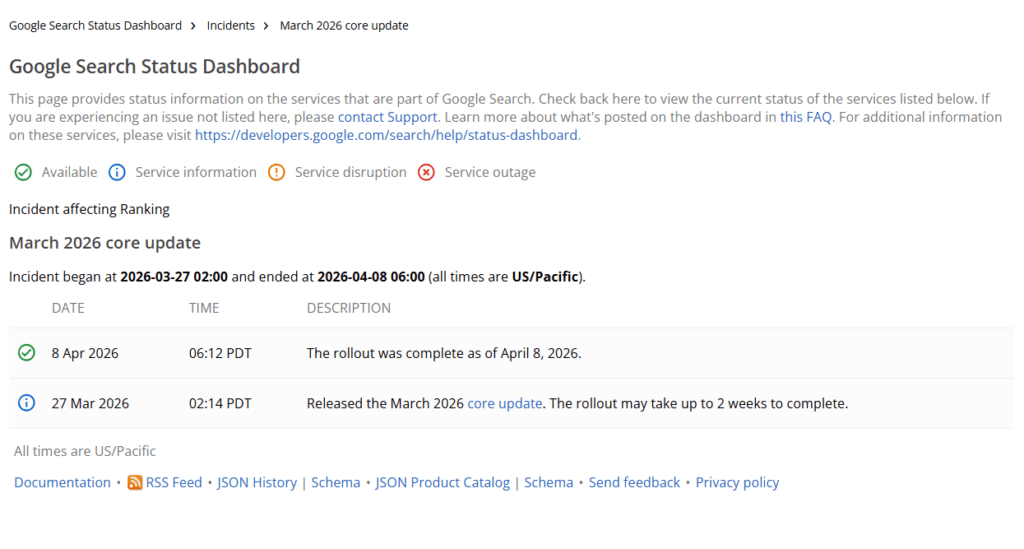
In summary, Google’s March 2026 Core Update completed on April 8, 2026. It ran for 12 days (March 27 – April 8) and affected over 55% of websites globally. Sites with thin content, weak topical authority, and poor E-E-A-T signals saw the sharpest drops. High-quality, structured, expert-led content benefited.
What happened:
The first major core update of 2026 was brutal for a specific category of sites. YouTube lost 567 visibility points in SISTRIX data, the largest single-domain drop in recent recorded history. Reddit, Instagram, and X also took significant hits. Meanwhile, IMDB, Amazon, Netflix, Apple, and Spotify gained measurable ground.
The pattern is clear when you look at who won and who lost. Sites that act as aggregators, user-generated content hubs, or thin “what to watch” publishers took the hardest blows. Sites with original content, first-party expertise, and structured depth climbed.
Key facts:
- Update duration: 12 days (fastest broad core update in over a year)
- Sites affected: 55%+ saw noticeable ranking changes
- Hardest hit categories: UGC platforms, aggregator sites, thin informational content
- Winners: First-party platforms, topic-authority publishers, original content creators
- Source: Google Search Status Dashboard
The Bhautik Kapadiya (SEO Consultant) Take:
I’ve been working on organic systems for over 4 years. In that time, I’ve seen one pattern repeat after every major core update: sites built on genuine topical depth, not keyword volume, survive. The March 2026 update confirmed it again, harder than most.
When I helped a UK B2B brand scale from 0 to 3,911 organic leads using structured content systems, topical clustering was the single biggest lever. Not link building. Not technical tweaks. Depth. That’s what this update rewarded.
If your traffic dropped after March 27, run a comparison in Search Console: March 1–23 vs. April 9 onwards. Find which pages dropped.
Ask one honest question about each: Does this page add something the top 3 ranking results don’t? If not, that’s where to start.
What Is Google’s New “Back Button Hijacking” Spam Policy?
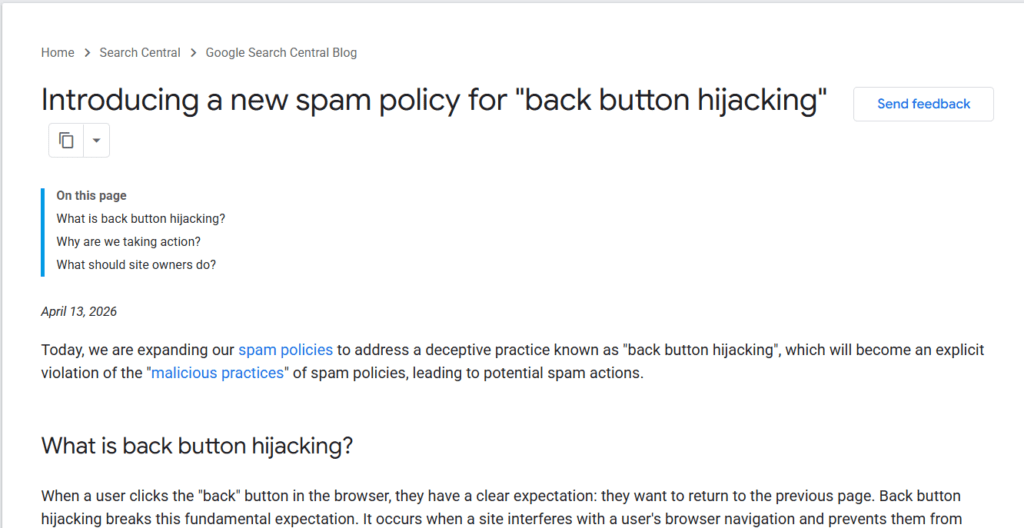
In summary: On April 13, 2026, Google officially added “back button hijacking” as a named violation in its spam policies. Websites that use JavaScript to intercept a user’s browser back button, redirecting them to another page instead of Google, are now formally at risk of spam action.
What happened:
It was a common grey-hat tactic. A visitor arrives from Google Search or Discover. They read your page, decide to leave, and press the browser back button. Instead of returning to Google, a JavaScript snippet catches that action and sends them to your homepage or another internal page, trapping them on your site.
The goal was to increase dwell time signals and lower bounce rates from Google’s perspective. But the strategy failed to deliver the expected results, and Google has now officially clarified its stance on it.
Why this matters for your site:
If your site (or a client’s site) uses this technique even unintentionally through a plugin or theme script, you are now at documented risk. Spam policy violations don’t always trigger immediate action. But they make you vulnerable in every future core update and spam update cycle.
Action required: Audit your JavaScript. Look for any code that listens to popstate, history.pushState, or window.onpopstate events and overrides the default back-button behaviour. Remove it.
Source: Google Search Central Blog
How Does Google AI Mode’s New Side Panel Affect Your Traffic?
In summary: From April 16, 2026, desktop users in Google’s AI Mode see website links open in a right-side panel rather than a new tab. Your content appears inline within the AI Mode interface, similar to how AMP worked in mobile search.
What happened:
When users browse Google’s AI Mode and click a website link, instead of leaving AI Mode, a side panel slides open showing your page. The user never fully transitions to your site.
This creates two outcomes, and which one applies depends on what Google decides to do with data attribution.
If Google counts side-panel views as impressions and clicks in Search Console, this is a net positive. Your brand gets exposure, your content is shown, and the data is captured.
If Google does not count them, this is a real problem. Your server is serving content, your hosting costs are real, but your organic traffic data shows nothing. Publishers get used without credit.
Watch your Search Console data closely in May and June 2026. If you see a gap between what your server logs show and what GSC reports, this is likely why.
Source: X / Twitter — @rmstein
What Google Ads Updates Happened in April 2026?
Google Ads had one of its busiest months in recent memory. Five separate updates rolled out across April.
Auto-Apply for Experiment Results (April 1)
In summary: Google Ads experiments now have auto-apply turned on by default. Previously, you chose whether to apply a winning experiment combination. Now, Google applies it automatically unless you turn this setting off.
This is a silent change that can alter live campaigns without explicit advertiser approval. If you have active experiments, check them now. Every new experiment you set up, turn off auto-apply as the first step.
Source: LinkedIn — @bmmeijer
Sponsored Ads in Google Images – Mobile (April 7)
Google began testing paid ads inside the Images tab on mobile search. If you run search ads with visual-oriented keywords, your ads can now appear in the image results. For e-commerce and local businesses, this is a new inventory opportunity. For organic SEO teams, it’s another reminder that Google is monetising previously organic placements.
Source: LinkedIn — @matteobraghetta
Copy-Paste AI Prompts Across Campaigns (April 7)
Google Ads now lets you copy tone and style prompts from one campaign’s AI text settings and paste them directly into another. If you’ve spent time defining your brand voice in one campaign, you can replicate it across all others without rewriting. Small update. Real-time savings at scale.
Source: LinkedIn — @arpan301
Swipeable Location Carousel in Search Ads (April 8)
Google is testing a swipeable location carousel format below search ads. Businesses with multiple branches can show all locations in a single swipeable unit. Instead of listing one location per ad, users scroll through branches directly in the search results. Excellent format for franchises, retail chains, and multi-location service businesses.
Source: LinkedIn — @anthony-higman
Single Toggle for Enhanced Conversions (April 10)
Google merged the separate Enhanced Conversions settings for Web and Leads into one toggle. Previously, advertisers configured each independently. Now, one toggle enables both simultaneously. This simplifies setup, especially for new advertisers, and removes a common configuration mistake where one was enabled without the other.
Source: Google Ads Help
What Are Google’s Updated “Read More” Deep Link Best Practices?
In summary: On April 20, 2026, Google published updated best practice guidance for “Read More” deep links and the expand buttons that reveal truncated content on a page. Three specific requirements were clarified.
The three rules:
- Immediate content reveal – When a user clicks “Read More,” the hidden content must appear immediately without requiring additional clicks, tab switches, or accordion interactions.
- No auto-scroll – When the content expands, the page should not auto-scroll. The user’s cursor and viewport should stay in place. The expanded content flows naturally below.
- History API hash preservation – If your site uses the History API to create URL-based states, ensure the hash fragment (#) remains intact after expansion. Don’t strip or modify it.
Important distinction: This applies specifically to pages where content is visually truncated and then revealed. It does not apply to internal links that use “Read More” as anchor text pointing to another page.
Source: Google Search Docs
What Is Google Analytics’ New Task Assistant?
In summary: On April 29, 2026, Google Analytics launched “Task Assistant” – a guided workflow tool that walks users through account setup, campaign creation, reporting configuration, and conversion tracking.
It’s positioned as a self-serve guide for business owners who want to manage their own Google Ads without hiring a PPC specialist. The interface surfaces step-by-step checklists tailored to your specific goal (e.g., “set up conversion tracking” or “create your first campaign”).
My honest take? The tool is designed to bring more self-serve advertisers into the Google Ads ecosystem. That’s good for Google’s revenue. Whether it’s good for the business owner to spend the budget is a separate question. Guided setup doesn’t replace strategy. If you’re a business owner considering running ads yourself – test it. But the moment you’re spending more than ₹50,000/month, get a specialist to audit the structure.
Source: Google Analytics Help
What Is Google’s Preferred Sources Update and Why Should Publishers Care?
In summary: On April 30, 2026, Google expanded its Preferred Sources feature to all supported languages worldwide. Users can now bookmark specific publishers in Google News and Discover, and Google will prioritise content from those sources in their feeds.
Why this matters for content creators and publishers:
When a user saves your site as a Preferred Source, your content gets priority placement in their Discover and News feeds, regardless of standard ranking signals. It’s a direct relationship between your brand and your audience, baked into Google’s algorithm.
This is one of the strongest arguments for building brand recognition, not just keyword rankings. If users know your name and seek you out, Google rewards that behaviour with preferred placement.
For Indian publishers: this feature originally launched in Hindi before English. It’s now available across all languages globally.
Source: Google Blog
OpenAI / ChatGPT – April 2026
OpenAI made two moves in April that every SEO and GEO strategist needs to understand clearly.
What Are ChatGPT CPC Ads and Why Do They Change Everything?
In summary: In April 2026, OpenAI launched cost-per-click (CPC) ads inside ChatGPT. Advertisers can now bid $3–$5 per click. The minimum campaign spend dropped from $200,000 (CPM-only at launch) to $50,000. A self-serve Ads Manager was opened to pilot advertisers. Ads are shown to logged-out users and Free/Go-plan subscribers. Pro, Business, and Enterprise users remain ad-free.
What changed and why it matters:
OpenAI launched its advertising program in February 2026 at a $60 CPM (cost per thousand impressions). Within ten weeks, CPMs had dropped to around $25, a sign that demand wasn’t matching supply at those rates. CPC was the natural response: tie revenue to action, not just exposure.
Here’s what this means in concrete terms:
| Model | Before (Feb 2026) | After (Apr 2026) |
|---|---|---|
| Pricing model | CPM only ($60/1,000 impressions) | CPC added ($3–$5/click) |
| Minimum spend | ~$200,000 | $50,000 |
| Ad Manager | Limited, manual | Self-serve (beta) |
| Ad targeting | Basic | Context hints + country-level |
| Who sees ads | Free users (US) | Free/Go users + AU, NZ, CA |
Sources: Digiday | Search Engine Land
What this means for SEO and GEO:
ChatGPT has 800 million weekly users. 97% don’t pay. That’s an enormous audience now exposed to paid ads inside a conversational AI interface.
For your brand, this creates two parallel pressures:
Pressure 1 – Paid: Competitors can now buy placement inside ChatGPT conversations when users ask questions relevant to your product or service. If you sell B2B SaaS tools, someone could be running a ChatGPT ad targeting “project management software for remote teams”, and your brand is invisible unless you’re either running ads or showing up organically.
Pressure 2 – Organic (GEO): The organic equivalent of ranking in ChatGPT is getting your content cited in AI-generated answers. That’s what GEO – Generative Engine Optimisation is about. If you haven’t built a GEO strategy yet, the barrier to your AI visibility just got more competitive. Paid placement now competes alongside organic citation.
This is not theoretical. I’m already factoring this into every SEO strategy session I run for clients. If you want to understand how GEO fits into your current organic system, my AI SEO Prompts Pack covers the exact prompts I use to optimise content for AI citation.
The Bhautik Kapadiya (SEO Consultant) Take:
LLM visibility is no longer just earned. It’s bought too. The businesses that will dominate AI search over the next 12 months are those building both organic GEO systems now and a testing plan for paid AI placements as the market matures.
Don’t wait for the platform to be perfect before you start. Early movers in Google Ads dominated for years because they understood the intent signals before everyone else. The same window is open in ChatGPT right now. It will close.
Where Is OpenAI Expanding ChatGPT Ads Next? {#ads-new-countries}
In summary: On April 17, 2026, OpenAI announced its expansion into Australia, New Zealand, and Canada – marking a major move beyond its initial US-focused rollout
If you operate businesses or manage clients in these markets, the competitive landscape inside ChatGPT has officially shifted. Paid ad inventory is now live across these regions, and brands that establish strong organic AI visibility (GEO) early, before advertising costs stabilise, will gain a significant competitive advantage.
Source: OpenAI Release Notes
What Did Microsoft Update in April 2026?
Microsoft made three interconnected updates to its advertising and analytics stack on April 21, 2026. Each one mirrors a Google feature, which follows their consistent pattern of close product alignment.
AI Max Ads in Microsoft Advertising
Microsoft launched its own version of Google’s AI Max campaign type inside Microsoft Advertising. The features are nearly identical: AI-optimised bidding, expanded match targeting, and automated ad generation. If you’re already running Google AI Max campaigns, evaluate Microsoft Advertising for an early-mover opportunity. Less competition. Same principles.
Microsoft Clarity – AI Citation Tracking (GEO Measurement Tool)
This is the most useful update for SEO and GEO practitioners. Microsoft Clarity – the free behaviour analytics tool can now show which specific sections of your page are being cited inside Bing’s AI-generated answers.
This is a direct measurement tool for your GEO efforts. You can see exactly which paragraphs, which data points, and which content blocks Bing’s AI is extracting. Use this to reverse-engineer what structure AI systems prefer on your site.
If you’re not using Microsoft Clarity yet, set it up today. It’s free. The GEO tracking feature alone makes it worth installing, even if Bing is a minor traffic source for you. Check your SEO Tools here for more free resources to track your organic performance.
UCP Support in Microsoft Merchant Centre
Microsoft added support for Google’s Universal Commerce Protocol (UCP) in its Merchant Centre. UCP is Google’s protocol for displaying shoppable products in AI Mode and Gemini answers. With Microsoft adopting it, products you’ve already optimised for UCP on Google are now automatically eligible to appear in Microsoft Copilot and Bing AI answers – with inline checkout.
One protocol. Two platforms. No extra setup required.
What Does April 2026 Mean for Your SEO Strategy?
April 2026 wasn’t a month of minor refinements. Three major structural shifts happened simultaneously across the search ecosystem:
Shift 1: Quality over volume got enforced at scale. The March 2026 Core Update didn’t just penalise bad content. It penalised thin content pages that technically follow best practices but don’t add something that doesn’t already exist in the search results. 55% of sites saw changes. That’s not a precision tool. That’s a reset.
Shift 2: AI search became a paid channel. ChatGPT’s CPC ads turned AI visibility into a hybrid of earned and paid. SEO was always supplemented by paid search. GEO now faces the same dynamic. Build your organic AI presence now before auction competition drives up costs.
Shift 3: Microsoft aligned its entire stack with Google. UCP support, AI Max ads, and AI citation tracking in Clarity all mirror Google’s moves directly. The implication: if you build for Google’s AI ecosystem, you get Microsoft’s for free. That’s a real efficiency gain if your clients target multiple markets.
For founders and businesses I work with across India, the US, and the UK, the message from April is consistent: build systems, not single-page tactics. The businesses that generate predictable organic growth are the ones that have depth across their content, structure across their site, and presence across both traditional and AI search.
That’s exactly what I help businesses build through my SEO and GEO services. If your site took a hit in April, or if you want to build AI visibility before your competitors do, let’s talk.
What Should You Do Right Now Based on April’s Updates?
Here’s a clear action list based on everything that happened in April 2026. Prioritised by urgency:
Priority 1: Audit your Search Console for the impact of core updates.
Compare traffic: March 1–23 (pre-update) vs. April 9–current (post-update). Filter by page. Find your top 5–10 commercial pages that dropped. For each: open the top 3 ranking results for its keyword and ask Does your page add something they don’t?
Priority 2: Check for back-button hijacking. Search your codebase for popstate, history.replaceState, and window.onpopstate with redirect logic. Check your plugins and themes. If anything overrides the browser back button, remove it now.
Priority 3: Start building your GEO strategy. ChatGPT CPC ads are live. Your organic AI presence matters now more than ever. Start with structured content: atomic answers, FAQ sections with proper H3 tags, entity-based writing, and clear data tables. My AI SEO Prompts Pack has the exact templates and prompts I use for GEO-optimised content.
Priority 4: Set up Microsoft Clarity for GEO tracking, a free tool. Shows which content sections Bing AI cites. Pair it with your Google Search Console data for a complete picture of organic and AI visibility. You can automate parts of this tracking using the workflows I cover in my SEO automation guide.
Priority 5: Enable UCP if you run e-commerce. One integration unlocks shoppable product visibility in Google AI Mode and Microsoft Copilot simultaneously. If you sell products online and haven’t set up UCP, this is the highest-leverage technical SEO task for e-commerce right now.
Priority 6: Review your Google Ads experiment settings. Auto-apply is on by default. Log into Google Ads, go to Experiments, and confirm no unwanted changes have been applied. Turn off auto-apply on all active and future experiments unless you specifically want Google to apply results automatically.
Conclusion
April 2026 confirmed what the data has been pointing to all year: SEO news April 2026 wasn’t about one update; it was about three platforms moving in the same direction simultaneously.
Google rewarded depth and punished thin content at scale. OpenAI turned ChatGPT into a performance marketing channel with CPC ads. Microsoft aligned its entire stack with Google’s AI protocols. The businesses that adapt across all three platforms, not just Google, are the ones that will dominate organic growth through 2026 and beyond.
The window to build organic AI visibility cheaply is narrowing. With each passing month, more advertisers enter the ChatGPT ad market, and organic GEO real estate becomes increasingly contested. Start now.
Want a growth system that shows up on Google and gets cited in ChatGPT? Book a strategy session and let’s build it together.
FAQs
What was the biggest SEO update in April 2026?
The March 2026 Core Update, which was completed on April 8, was the most impactful event of the month. It ran for 12 days, affected over 55% of websites globally, and produced the largest single-domain visibility drop in recent SISTRIX history (YouTube, -567 points). Sites with thin content and weak topical authority saw the sharpest declines. Sites with structured, expert-led content gained ground.
Did the March 2026 Core Update penalise my website?
No – core updates don’t issue penalties. They re-rank pages based on updated quality signals across the entire web. If your traffic dropped after March 27, it means Google re-evaluated your content and ranked it differently relative to competitors. The fix is not technical.
It’s content depth: does your page add something that the top-ranking pages don’t already cover? Focus on topical authority, E-E-A-T signals, and structured content to recover.
What are ChatGPT CPC ads, and how do they affect SEO in 2026?
ChatGPT CPC (cost-per-click) ads allow advertisers to pay $3–$5 per click for placement inside ChatGPT conversations. Launched in April 2026, they turn ChatGPT from a branding surface into a performance marketing channel.
For SEOs, this means AI visibility now has a paid layer alongside organic citation (GEO). Brands that don’t build organic AI presence now will face ad competition from day one when they eventually try to compete.
What is Back Button Hijacking, and why is it now a Google spam violation?
Back Button Hijacking is a JavaScript technique that intercepts a user’s browser back button and redirects them to another internal page – instead of returning to Google. Websites used this to artificially inflate dwell time. On April 13, 2026, Google officially added this to its spam policies.
Review your JavaScript and eliminate any code that interferes with the browser’s native back-navigation functionality.
What is GEO, and why does it matter in 2026?
GEO (Generative Engine Optimisation) is the practice of structuring your content so that AI systems like ChatGPT, Perplexity, and Google AI Overviews cite your brand in their answers.
With 60% of searches ending without a click, and ChatGPT now running paid ads, organic AI visibility is one of the highest-leverage investments a brand can make. GEO requires atomic answer blocks, entity-based writing, structured FAQs, and clear data tables not just keyword optimisation.
How can I check if the March 2026 Core Update affected my website?
Open Google Search Console. Go to Performance → Search Results. Use Compare mode: set Date Range 1 as March 1–23, 2026 (pre-update) and Date Range 2 as April 9 onwards (post-update). Filter by page. Look for pages with a significant drop in clicks and impressions. Focus your recovery effort on the 5–10 pages with the highest commercial value that dropped the most.