
Your content ranks #1 on Google. But when a potential buyer types a question into ChatGPT, your brand doesn’t appear. Your competitor does.
That gap is not an SEO problem. It’s a GEO problem. And it’s costing businesses real revenue right now.
According to research by Bain & Company published in February 2025, around 80% of consumers now use AI-generated answers for at least 40% of their searches, while nearly 60% of searches end without users clicking through to any website. AI platforms are increasingly delivering answers directly, often before users ever reach your site.
This guide covers GEO optimisation 2026 from the ground up: what it actually is, how each major AI platform picks its sources differently, and the exact system you need to get your brand cited in ChatGPT, Claude, Perplexity, and Google AI Overviews. Real tactics, verified data, no theory.
What Is GEO Optimization? (The 2026 Definition)
GEO (Generative Engine Optimisation) is the practice of structuring your content so that AI platforms cite it when generating answers for users. Do not rank it in a list. Cite it inside the answer itself.
Traditional SEO gets you a blue link. GEO gets you inside the response.
Think of it this way: SEO gets you clicked. GEO gets you quoted.
The term was first defined in a 2023 Princeton University research paper, which found that GEO techniques can increase content visibility in AI responses by 30–40%. By 2026, this is no longer an experiment; it’s the difference between brands that exist in AI search and those that don’t.
Why Every Business Owner Should Pay Attention Right Now?
The numbers make the urgency clear:
- AI-referred sessions grew 527% year-over-year between January and May 2025, jumping from 17,076 to 107,100 sessions across 19 GA4 properties, according to the Previsible 2025 AI Traffic Report.
- ChatGPT now serves 800 million weekly active users, more than the entire population of Europe (Reuters, February 2026)
- 60% of all searches now end without a click, according to Bain & Company
- When an AI Overview appears, organic CTR drops by 61% (Seer Interactive, 2025)
- 32% of sales-qualified leads at early GEO adopters now come directly from AI search (Profound AI Citation Analysis, 2026)
The window to establish AI citation authority is open right now. Every month you wait, competitors are building the citation history that AI models will favour going forward.
GEO vs. SEO vs. AEO: What’s the Actual Difference?
These three terms get confused constantly, even by experienced marketers. Here’s the clear breakdown:
| Dimension | SEO | AEO | GEO |
| Goal | Rank in Google’s blue links | Appear in answer boxes and voice results | Get cited inside AI-generated responses |
| Target platforms | Google, Bing | Featured snippets, voice search | ChatGPT, Claude, Perplexity, Gemini |
| Key metric | Rankings, organic traffic | Position zero, direct answers | Citation frequency, Share of Model (SoM) |
| Content format | Keyword-optimised pages | Q&A, FAQ, concise answers | Structured, data-rich, extractable chunks |
| Status in 2026 | Foundation still essential | Supplements SEO | Extends both into the AI layer |
The key insight: GEO doesn’t replace SEO. AI platforms pull from indexed web content, so your existing crawlability, domain authority, and E-E-A-T signals are still the foundation. GEO is the strategy you build on top of that foundation to get cited, not just ranked.
How does each AI Platform Actually Selects Its Sources?
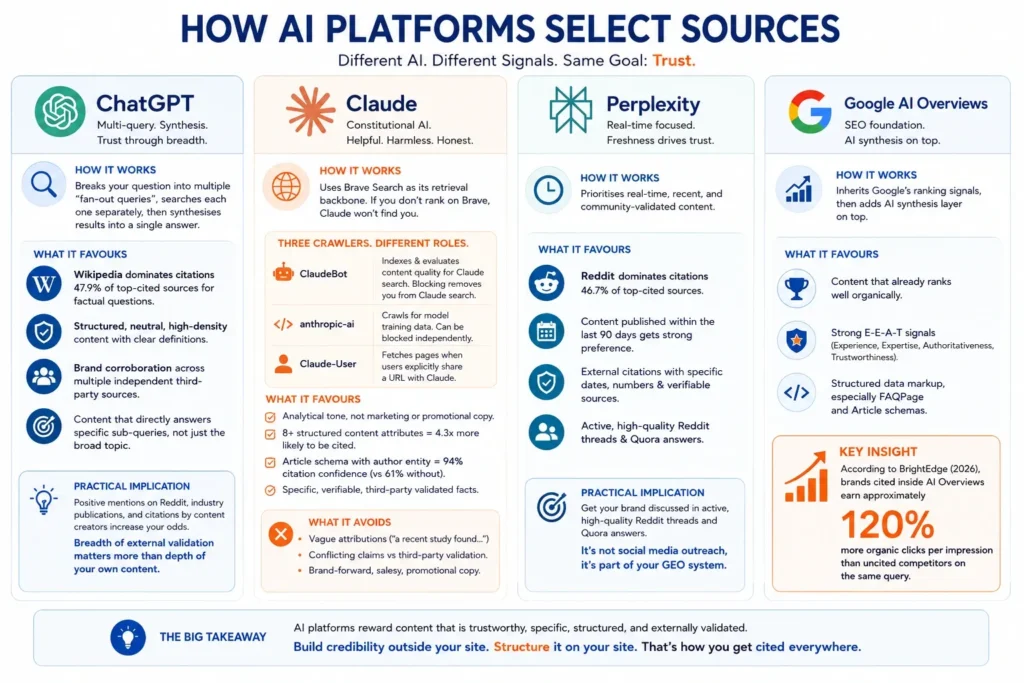
This is where most GEO guides get it completely wrong. They treat ChatGPT, Claude, and Perplexity as the same system. They’re not. Each has its own citation logic, trust hierarchy, and content preferences.
How ChatGPT Selects Sources?
ChatGPT operates in two modes: its base training data (pre-knowledge cutoff) and live browsing mode (real-time retrieval). Most queries today use both.
In browsing mode, it breaks your question into multiple smaller sub-queries, which researchers call “fan-out queries”, searches each one separately, then synthesises the results into a single answer.
What ChatGPT favours:
Wikipedia dominates ChatGPT’s citations. Research shows that it accounts for 47.9% of ChatGPT’s top-cited sources for factual questions. That tells you exactly what the model values: structured content, neutral tone, clear definitions, and high information density. You can’t become Wikipedia, but you can write like it.
Beyond Wikipedia: brand corroboration across multiple independent third-party sources, content that directly answers the specific sub-query rather than the broad topic, and overall domain readability all signal trust to ChatGPT.
Practical implication: If your brand is discussed positively on Reddit, mentioned in industry publications, and cited by other content creators, ChatGPT is far more likely to include you. The breadth of external validation matters more than the depth of your own content.
How Claude AI Selects Sources?
Claude is the hardest AI platform to cite. But here’s the strategic upside: brands that earn Claude citations almost always do so on ChatGPT and Perplexity, too. Crack Claude, and you’ve cracked AI search.
The most important fact most GEO guides miss: Claude uses Brave Search as its retrieval backbone. If your content doesn’t rank on Brave, Claude won’t find it regardless of your Google domain authority.
Anthropic runs three separate crawlers, and you need to know each one:
- ClaudeBot – This indexes and evaluates content quality for Claude’s search results. Blocking this in your robots.txt removes you from Claude-powered search entirely.
- anthropic-ai – This crawls for model training data. You can block this independently without affecting your search visibility.
- Claude-User-This fetches pages when users explicitly share a URL with Claude.
All three honour robots.txt, unlike other AI crawlers.
What Claude favours:
Anthropic’s Constitutional AI values shape Claude’s citation selection: content must be helpful, harmless, and honest. Promotional copy, vague attributions, and salesy language are actively deprioritised even when the facts are accurate. Write in an analytical tone, not a marketing tone.
The data on attributes matters significantly here. Research by Erlin.ai across 500+ brands (2026) found that brands with 8 or more structured content attributes get cited 4.3x more often than brands with fewer than 3. Specificity signals trust.
On author authority: when Article schema explicitly declares an author entity, Claude cites that content with 94% confidence, compared to 61% for plain text with no author markup (upGrowth, 2026). A named author with verifiable credentials is required for a Claude citation.
What Claude avoids: vague source attributions (“a recent study found…”), content that conflicts with third-party validation of the same claims, and anything that reads as brand-forward promotional copy.
How Perplexity Selects Sources?
Perplexity is one of the most real-time focused AI search platforms among major AI search engines. It places strong emphasis on content freshness, recent updates, and sources that are validated through community discussions and trusted references.
Reddit accounts for 46.7% of Perplexity’s top-cited sources, making it the single biggest signal for Perplexity visibility. Content published within the last 90 days gets strong preference. External citations to authoritative sources with specific dates and verifiable numbers perform significantly better than general claims.
Practical implication: Getting your brand discussed in active, high-quality Reddit threads and Quora answers is direct Perplexity optimisation. It’s not social media outreach, it’s part of your GEO system.
How does Google AI Overviews Select Sources?
Google AI Overviews inherit Google’s traditional ranking signals, then add an AI synthesis layer on top. This makes them the most predictable of the four platforms for brands that already invest in SEO.
They prioritise content that already ranks well organically, shows strong E-E-A-T signals, and uses structured data markup, particularly the FAQPage and Article schemas. According to BrightEdge research (2026), brands cited inside AI Overviews earn approximately 120% more organic clicks per impression than uncited competitors on the same query.
This is the most important data point about AI Overviews: being cited makes your standard organic results perform dramatically better, not just the AI answer.
The 8 GEO Optimisation Tactics That Work in 2026
1. Lead With the Answer Every Single Time
AI models use Retrieval-Augmented Generation (RAG) to extract specific passages from your content. They don’t read your full article. They extract the most relevant chunk.
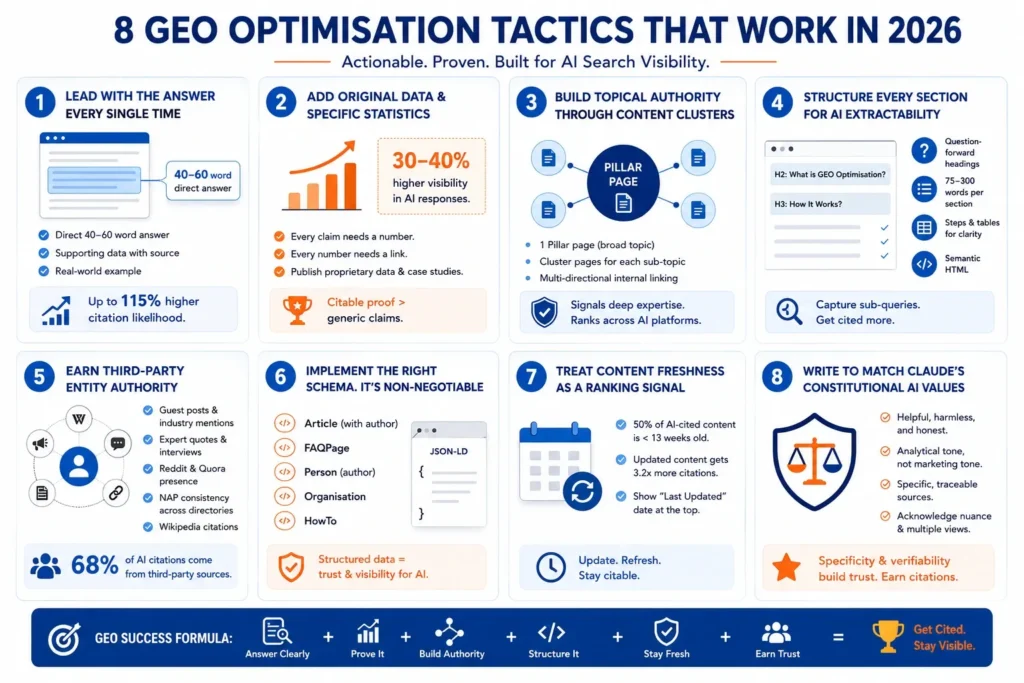
That means your opening 40–80 words under every H2 need to stand completely alone as a direct answer to the question the heading poses. No build-up. No preamble. Answer first, explain second.
Princeton’s foundational GEO research found that placing a concise, self-contained answer in the opening paragraph can improve citation likelihood by up to 115%. This is the highest-impact single change you can make to any existing piece of content.
The structure that works:
- Direct 40–60 word answer (the extractable chunk)
- Supporting data or evidence with a source link
- Real-world example or practical breakdown
This format is what I use across all content I build for clients, and it’s what helped me take a UK B2B brand from 0 to 1 Ranking in 20 Days entirely through structured organic content, no paid ads.
2. Add Original Data and Specific Statistics With Source Links
AI models look for “anchors” when generating answers, such as hard numbers, specific percentages, and verifiable data points that give the response substance. Generic claims get skipped.
Content with statistics, citations, and expert quotes achieves 30–40% higher visibility in AI responses, per Princeton’s GEO research.
The practical rule: every claim needs a number, and every number needs a link.
Don’t write: “AI search is growing fast.” Write: “AI-referred sessions grew 527% in just five months in 2025, according to the Previsible AI Traffic Report.”
The second version is quotable. The first is invisible to AI models.
Your strongest move: publish proprietary data from your own client work. Original case studies, internal benchmarks, campaign results with specific numbers. This is content AI engines cannot find elsewhere, so they cite it.
When I generated 7,800+ leads for a US local business using hyper-local SEO, documenting that specific number with a transparent case study made it a citable proof point, not just a testimonial.
3. Build Topical Authority Through Content Clusters
AI engines don’t just evaluate individual pages. They evaluate your overall depth on a topic through your interconnected content architecture. A single great article is weaker than a pillar page surrounded by five supporting cluster pages that all reinforce the same expertise.
The content cluster structure for GEO:
- One Pillar Page covering the broad topic (this article is an example)
- Cluster pages for each sub-topic, e.g., “How to optimise for Perplexity”, “Claude citation tracking guide”, “GEO metrics you should be measuring”
- Multi-directional internal linking: the pillar links to each cluster, each cluster links back to the pillar, and related clusters link to each other.
This semantic web signals deep topical expertise to both Brave’s ranking algorithm (critical for Claude) and each AI platform’s source selection logic. For a look at how this cluster approach works in practice, see my SEO & AI Growth Services page.
4. Structure Every Section for AI Extractability
Because AI platforms break queries into sub-queries before searching, your content needs to rank for the smaller questions, not just the broad head term. Think about what fragment of a complex question you’d type into a search bar and make sure a section of your article answers exactly that.
Structural rules that improve AI extractability:
- Use question-forward H2/H3 headings (“What Is GEO Optimisation?” not just “Definition”)
- Write every section as 75–300 words covering one idea completely.
- Use numbered steps for process content, and comparison tables for options-structured formats are far easier for AI to parse and cite accurately.
- Use semantic HTML <article>, <main>, <section> tags so AI crawlers can isolate your content from navigation and ads cleanly
Fan-out queries are becoming increasingly important. When someone asks ChatGPT, “How do I get my brand to appear in AI search results?”, the model may break that into multiple supporting searches such as “GEO optimisation in 2026,” “how ChatGPT chooses sources,” and “AI citation best practices.” That means your content must address the entire query ecosystem, not just the main topic.
5. Earn Third-Party Entity Authority Off Your Own Site
Here’s the trust signal most people miss: 68% of all AI citations across platforms come from third-party sources, not brand-owned websites. AI engines don’t trust what you say about yourself. They trust what others say about you.
This is not just PR advice. It’s a core GEO requirement.
Tactics that build third-party entity authority:
- Guest articles in industry publications relevant to your niche
- Expert quotes in other creators’ content, podcasts, and video interviews
- Genuine presence in Reddit and Quora discussions where buyers ask questions
- Consistent, accurate business information across all directories (NAP consistency matters for local entity recognition)
- Wikipedia citations where you genuinely have notable, verifiable information
The goal is simple: when an AI model cross-references a claim about your expertise, it should find multiple independent sources confirming it, not just your own website.
I ranked a brand-new, 40-day-old website at 1 in India and #2 in the USA within 20 days, partly because the content strategy deliberately built external validation signals alongside on-page optimisation. You can see the full breakdown in that case study.
6. Implement the Right Schema. It’s Non-Negotiable
Structured data is not optional for GEO in 2026. It’s how AI crawlers verify content credibility and reliably extract structured information.
The schema you need on every article:
- Article schema with an explicit author entity. This single change moves Claude’s citation confidence from 61% to 94%
- FAQPage schema on every FAQ section, AI Overviews, and Perplexity extract the FAQ schema verbatim
- Person schema for the author, linked to verifiable profiles (LinkedIn, personal site)
- Organisation schema for your brand entity
- HowTo schema for any step-by-step instructional content
Technical requirements alongside schema:
- Allow GPTBot, ClaudeBot, PerplexityBot, and BingBot in your robots.txt; blocking any of these removes you from that platform’s citation pool.
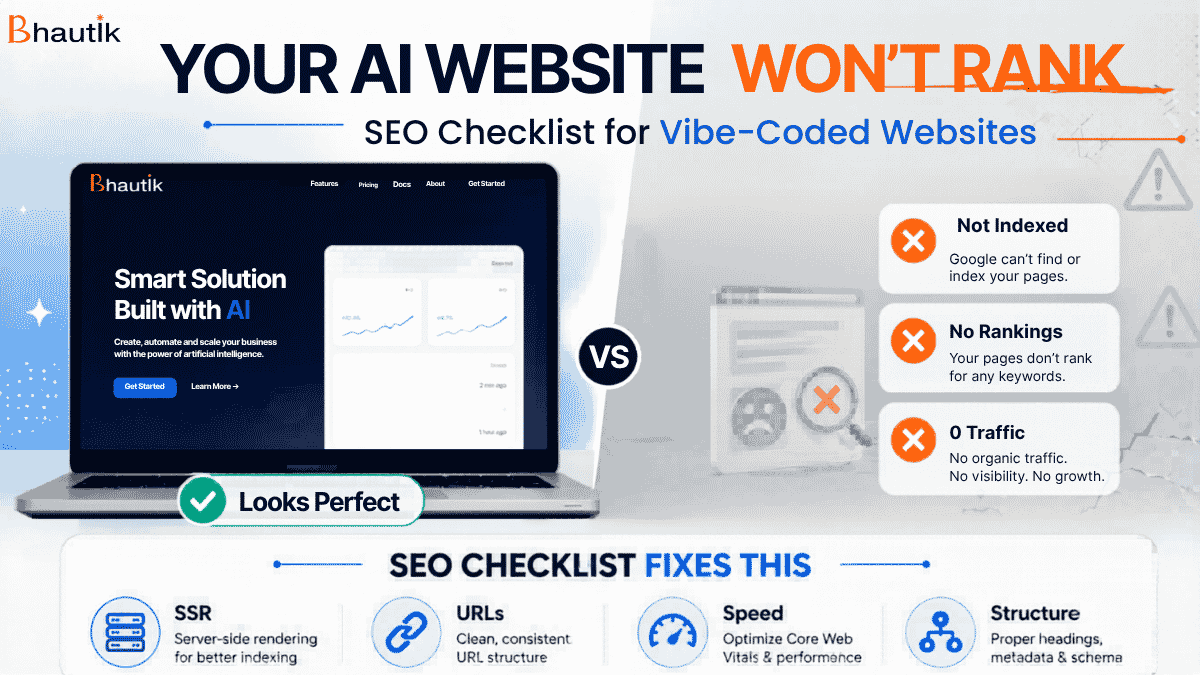
- Implement Server-Side Rendering (SSR). AI crawlers need content immediately available, not JavaScript-rendered after load.
- Use semantic HTML structure throughout (<article>, <main>, <section>)
- Consider an llms.txt file in your root directory to guide AI agents about your site’s content structure.
7. Treat Content Freshness as a Ranking Signal
Research by LLMrefs (early 2026) found that 50% of content cited in AI answers is less than 13 weeks old. Content over 90 days old sees citation rates drop sharply. Pages updated within the last 30 days receive 3.2x more citations than older material, according to Lureon.ai’s 2026 analysis.
This isn’t just about publication date. It’s about visible update signals that AI crawlers can detect.
The freshness system that works:
- Display a visible “Last Updated: [Month Year]” date at the top of every article
- Update statistics, data points, and source links every 30–90 days.
- Add an explicit version note when you make major content additions (e.g., “Updated May 2026, added Claude crawler breakdown and Q1 data”)
- Set recurring calendar reminders for your top-performing pages to prevent updates from slipping.
For a GEO-focused website, freshness maintenance is not an editorial nice-to-have. It’s a citation maintenance task.
8. Write to Match Claude’s Constitutional AI Values
This tactic is specific to Claude, but it improves your content quality across all platforms.
Claude’s citation selection is shaped by Anthropic’s Constitutional AI (CAI) framework.
Content must be helpful, harmless, and honest, not just technically accurate. Promotional tone, exaggerated claims, and vague source attributions are actively deprioritised even when the underlying fact is correct.
What this means practically:
- Write in an analytical, operator tone, not a marketing tone.
- Acknowledge nuance and limitations; don’t present everything in black-and-white.
- Use specific, traceable source attributions: not “a recent study found” but “according to the Previsible AI Traffic Report (2025)”
- Present multiple perspectives on contested topics rather than one-sided advocacy.
- Let your results speak: “I helped a UK B2B brand reach 3,911 organic leads using this system” is a factual, verifiable claim far stronger than “I’m an expert in this field”
Claude rewards specificity and verifiability. Every vague claim is a failure of trust.
How to Run a GEO Audit Right Now? (Free, 30 Minutes)
Before you build anything new, establish your baseline. You need to know where your brand stands across each AI platform before you can measure improvement.
The manual GEO audit starts today:
- Write out 15–20 questions your buyers ask when researching your category
- Query each one in ChatGPT, Claude, Perplexity, and Google AI Overviews separately
- Note which brands appear in each answer, and where yours appears (or doesn’t)
- Track the structure and tone of content that gets cited. Understand which content formats each AI platform prefers and how information is presented. Different platforms often prioritise different styles, structures, and levels of detail.
- Document your Share of Model (SoM) baseline: citation frequency ÷ total queries tested
Run this audit monthly. The changes you see month over month are your GEO performance data.
Tools that automate AI citation tracking:
- Otterly.ai monitors brand mentions across AI platforms; it starts at $39/month, with the lowest barrier to entry.
- Profound enterprise-grade platform tracking 10+ AI engines, including ChatGPT, Claude, Perplexity, and Gemini
- Semrush Enterprise AIO tracks visibility across ChatGPT, Google AI Mode, and Perplexity.
- Ahrefs Brand Radar tracks brand mentions in AI Overviews and generative search.
- SE Ranking tracks citations in ChatGPT and Perplexity by target keyword.
- GA4 – configure custom dimensions to capture AI referral traffic from known user agents: ChatGPT-User, PerplexityBot, Claude-Web
The metric that matters most: Share of Model (SoM), how often your brand appears in AI-generated responses compared to competitors, for your target queries, across all relevant platforms. This is the GEO equivalent of keyword rankings.
If you need expert support in building this tracking system and designing the right content architecture, you can explore my SEO & AI growth services or book a strategy session directly through Topmate.
Platform-by-Platform GEO Quick Reference
| Platform | Primary Citation Signal | Unique Requirement | What to Avoid |
| ChatGPT | Wikipedia-style authority, multi-source corroboration | Brand mentioned across forums and third-party sites | Thin content with no data or citations |
| Claude | Brave Search ranking + Constitutional AI alignment | ClaudeBot access, author credentials, verifiable facts | Promotional tone, vague attributions |
| Perplexity | Freshness + Reddit/forum presence | Published within 90 days, external source links | Outdated statistics, no timestamps |
| Google AI Overviews | Existing Google rankings + E-E-A-T | FAQPage schema, organic authority | Pages with thin or no structured data |
About the Author
Bhautik Kapadiya (BK) is an AI Growth, SEO, and GEO Strategist based in Ahmedabad, India. He helps bootstrapped SaaS founders, B2B brands, and service businesses grow with AI-powered SEO systems that turn organic traffic into predictable revenue.
Verified results:
- Ranked a 40-day-old website #1 in India and #2 in the USA within 20 days using an intent-driven content strategy
- Generated 7,800+ leads for a US local business using hyper-local SEO across multiple locations
- Delivered 27.5M+ impressions for a CAD platform with CTR improvement from 2% to 5.5% over 12 months
- Grew a WordPress SaaS plugin to 7.9K+ monthly traffic with 1K+ ranking keywords from Page 3–5 to Page 1, without paid ads
- Rated 5.0/5 on Topmate with 14+ verified bookings | Top 5% of creators on the platform
Connect: LinkedIn · Website · Topmate · Instagram
Conclusion
GEO optimisation in 2026 isn’t something you can put off. It’s happening right now, and the brands building AI citation authority today are creating a compounding advantage that will be genuinely difficult for late movers to overcome.
The system is clear. Lead with direct answers, add specific data with verifiable source links, build topical authority through content clusters, implement the right schema, earn third-party validation on your own site, and give every AI crawler clean access to your content. Do these eight things consistently, and your brand starts showing up where 800 million people are already looking for answers.
Start with the free audit: 15 questions, 4 platforms, 30 minutes. See exactly where you stand today. Then build from there.
Want the system built for your brand? Book a strategy session on Topmate or explore my GEO and AI SEO services.
Frequently Asked Questions
What is GEO optimisation in 2026?
GEO (Generative Engine Optimisation) is the practice of structuring your content so that AI platforms like ChatGPT, Claude, Perplexity, and Google AI Overviews can cite it in their generated answers. Unlike traditional SEO, which targets ranked links, GEO optimisation 2026 focuses on getting your brand into the AI-generated responses themselves, where the majority of modern search behaviour now occurs.
How is GEO different from SEO?
SEO gets you a ranked link that users have to click. GEO gets your brand quoted or cited directly inside an AI’s synthesised answer. SEO measures rankings and traffic; GEO measures citation frequency and Share of Model (SoM). Both are needed in 2026. GEO is built on top of your SEO foundation, not instead of it.
How do I get my content cited by ChatGPT?
Add original statistics with source links, earn your brand mentions in Reddit threads and third-party publications, use question-forward headings, and implement FAQPage schema. ChatGPT favours Wikipedia-style authority; the more independent external sources corroborate your brand, the higher your citation probability.
How do I rank in Claude AI search?
Claude uses Brave Search as its retrieval backbone, with 86.7% of citations overlapping with Brave’s organic results. So ranking in Brave is the prerequisite. Beyond that: allow ClaudeBot in your robots.txt, write in an analytical (not promotional) tone, add verifiable author credentials with Article schema, cite primary sources with specific attributions, and ensure your content has been updated within the last 90 days.
What is Share of Model (SoM)?
Share of Model is the primary GEO metric. It measures how often your brand appears in AI-generated responses compared to competitors for your target queries. To build your baseline: query ChatGPT, Claude, Perplexity, and Google AI Mode with your 15–20 most important industry questions and track citation frequency, position, and sentiment across each platform monthly.
How long does GEO optimisation take to show results?
Most brands see initial citation improvements within 4–8 weeks of implementing structural changes, answer-first content, schema, and freshness signals. Building full topical authority and third-party entity signals takes 3–6 months of consistent work. The long-term advantage is significant: once AI models recognise a source as reliable on a topic, they develop a citation preference for that source on related queries as well.
Is GEO only for large brands?
Not at all. In fact, GEO is a significant opportunity for focused niche experts. AI engines prioritise depth of topic over brand size. A specialist who covers one area thoroughly with structured, data-rich content can outrank much larger brands for AI citations in that niche. The key is to cover your niche completely, not to cover everything broadly.