Bhautik Kapadiya
HomeAI SEO vs Traditional SEO
Analysis & Strategy

AI SEO vs Traditional SEO (2026):
The Honest Comparison

In June 2025, LLM-powered search captured 5.6% of U.S. desktop search traffic - more than double what it was a year earlier. Traditional search still holds the majority. That single stat tells you everything: it's not a takeover. It's a split.

5.6%
U.S. Desktop AI Traffic
Up from 2.48% (Datos & Semrush)
~40%
Zero-Click AI Resolutions
Resolved in AI before website visits
27.5M+
Proven Baseline
Stunning case study impressions

I run SEO + GEO (Generative Engine Optimization) systems for clients across the US, UK, and India - and I get this question in almost every discovery call now: “Should I even bother with traditional SEO anymore, or just chase ChatGPT visibility?”

Short answer: wrong question. Here is the right one, answered properly.

What's Actually Different (Side-by-Side)

Nobody has a genuinely clean comparison verdict - most agency blogs ramble into 3,000 words without giving a crisp overview. Let's lay down the concrete differences immediately:

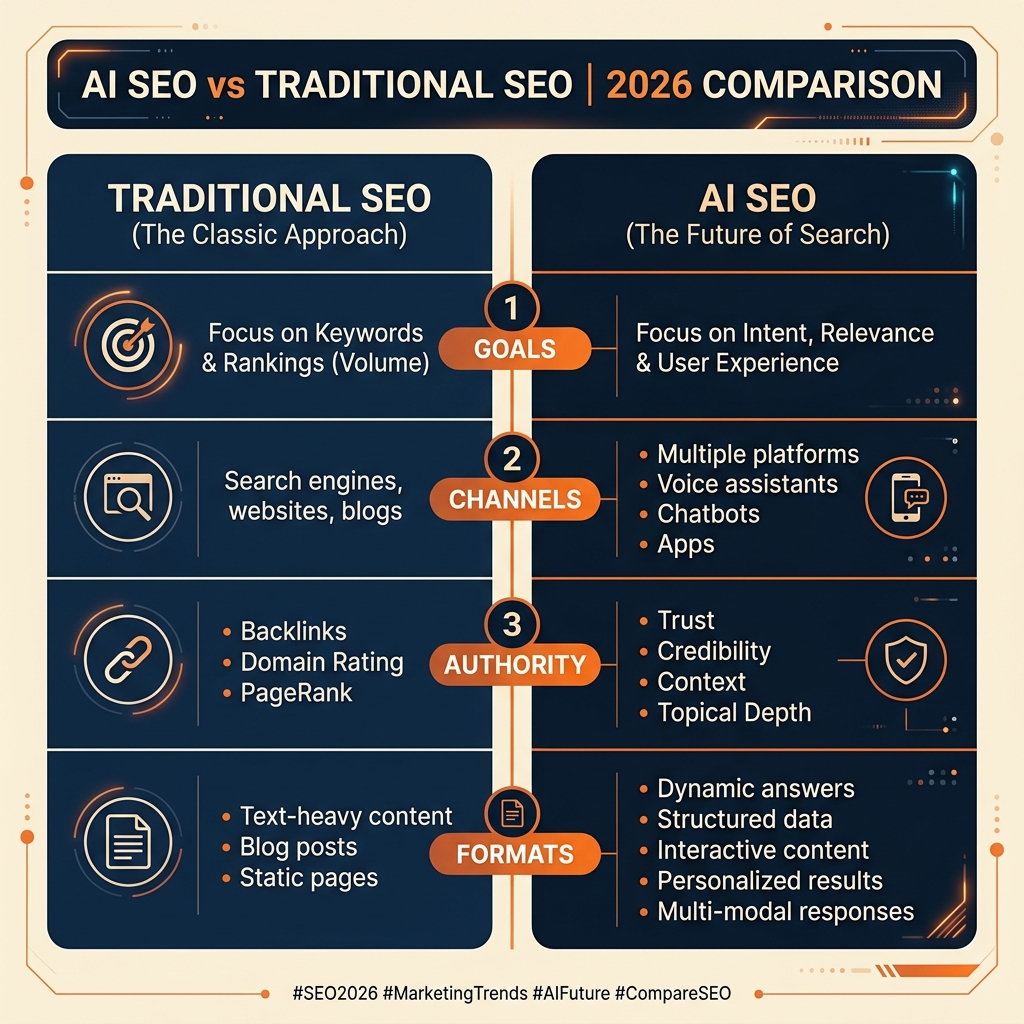
FeatureTraditional SEOAI SEO (GEO)
GoalRank in Google's blue linksGet cited inside AI answers (ChatGPT, Perplexity, Gemini, Google AIO)
Core SignalsKeywords, backlinks, technical health, on-page structureEntity clarity, answer-first content, brand mentions, structured data
Where it showsGoogle / Bing search results pagesChatGPT, Perplexity, Google AI Overviews, AI Modes
Authority CurrencyBacklinks + Domain AuthorityBacklinks plus unlinked brand mentions across reviews, forums, and publications
Content FormatLong-form, keyword-mapped, internally linked pagesDirect-answer blocks, tight Q&A structure, scannable prompt-matching H2s
MeasurementRankings, organic traffic, Search Console clicksAI citation frequency, share of voice in answers, prompt-based monitoring
User BehaviorVisitor researches, compares, and chooses on-siteVisitor arrives pre-decided; the AI engine already did the comparison for them
Can you skip it?No. It is the foundation. AI systems still need crawlable, indexed, authoritative content to synthesize.No. Roughly 40% of zero-click sessions are resolved entirely inside AI answers without a click.
AI SEO vs traditional SEO comparison table 2026
Figure 1: AI SEO (GEO) vs Traditional SEO 2026 comparison infographic
Strengths & Tradeoffs

Pros & Cons - Compared

🔍 Traditional SEO

The Pros:

  • Mature, highly measurable, and predictable once a system is set up (funnel is straightforward).
  • Every major AI engine still relies on it - without indexable, structured content, there is nothing for AI to scrape.
  • Strongest for high-intent, “ready to buy” user search behaviors.

The Cons:

  • Slower to show compounding results without a strong technical + content setup.
  • Competes for space on the page with AI-generated answers, which can decrease click-through rates even for #1 ranks.
  • Thin, keyword-stuffed articles are actively penalized in search rankings.

🤖 AI SEO (GEO)

The Pros:

  • Captures the high-intent buyer who doesn't use standard search engines at all.
  • Unlinked brand mentions now carry weight, letting smaller or newer sites break through.
  • Compounds extremely fast once recognized as a trusted entity in your niche.

The Cons:

  • Harder to measure; requires manual prompt logging since there is no default console dashboard.
  • No guarantees. No tool or specialist can promise permanent inclusion in AI citations.
  • Completely useless without a solid technical SEO foundation underneath it.
BK

My Honest Take

Bhautik Kapadiya · AI SEO & GEO Consultant

“Traditional SEO is the floor. GEO is the ceiling. You don't get to skip the floor.”

If your site isn't crawlable, isn't structured, and doesn't have any authority signal, no amount of “answer-first content” will get you cited by ChatGPT - the model has nothing credible to pull from. I've seen this exact failure mode: brands rushing to “optimize for AI” while their core technical SEO is still broken. It doesn't work.

It's the same reason one of my own case studies - ranking #1 in India and #2 in the USA in 20 days on a brand-new site - only worked because the technical and content foundation was built correctly from day one, not bolted on after.

Once that foundation is solid, GEO is where the compounding advantage lives right now, because most of your competitors haven't touched it yet. On a recent CAD platform project, fixing the technical + content layer over 12 months took impressions from a stagnant baseline to 27.5M+ impressions with CTR climbing from 2% to 5.5% - that's the traditional-SEO engine working exactly as it should.

The next layer - making sure that same content gets cited when someone asks ChatGPT the equivalent question - is the part almost nobody in that space has built yet. That gap won't stay open forever.

My 90-Day Recommendation:

Fix your technical & content foundation first if it isn't solid. Once that floor is built, route your next efforts directly into GEO - entity clarity, schema, structured answers, and tracking your actual AI citation frequency. Not instead of SEO. After it.

Direct Answers

Frequently Asked Questions

Structured to answer both human readers and search engine crawlers accurately.

No. Traditional SEO is not dead - it's the foundation everything else, including AI SEO, depends on. AI systems need crawlable, indexed, authoritative web content to generate their answers from. A site with strong AI-search visibility but no technical SEO foundation underneath it doesn't exist in most real cases.
Combined SEO + GEO Audit

Want to know exactly where your site stands in Google and AI answers?

I run a combined audit checking both: your traditional ranking health and whether ChatGPT, Perplexity, and AI Overviews are actually citing you right now. It's the same system that took a brand-new site to #1 India / #2 USA in 20 days.