SEO for business coaches means ranking your site for the problems your buyers search, like "first-time manager training" or "sales coaching for founders." Pick one niche, build one page per offer, show real client results, and structure every page so Google and AI tools can quote it.
This guide covers the exact 7 steps. If you want this done for you, see my SEO for coaches service.
TL;DR
- Business coaches rank faster by targeting buyer problems, not the word "coaching."
- Follow 7 steps: niche, keywords, service pages, proof, local SEO, AI search, authority.
- Expect first leads in 3 to 6 months. Real momentum shows up between months 6 and 12.
- Answer questions directly. That's what Google and ChatGPT both reward.
What Is SEO for Business Coaches?
SEO for business coaches is the work of getting your coaching site to show up when a founder, executive, or HR lead searches for help. That includes Google rankings, local results, and AI answers from ChatGPT, Perplexity, and Google AI Overviews.
The goal isn't traffic. It's booked discovery calls from people who already have the problem you solve.
Why Does SEO Matter for a Coaching Business in 2026?
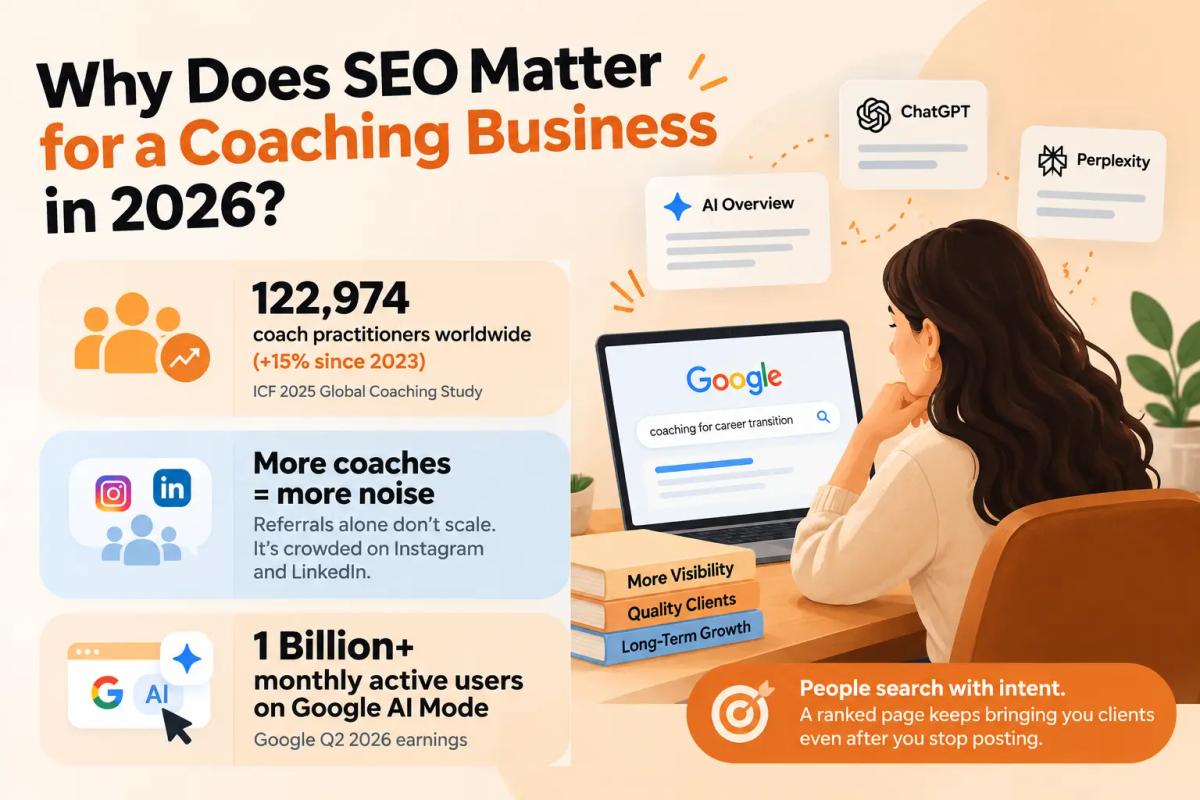
Because the market is crowded and referrals alone don't scale. The ICF 2025 Global Coaching Study counted a record 122,974 coach practitioners worldwide, up 15% since 2023.
More coaches means more noise on Instagram and LinkedIn. Search is different. The buyer comes to you with intent, and a ranked page keeps working after you stop posting.
Search also now includes AI. In its Q2 2026 earnings remarks, Google said AI Mode passed 1 billion monthly active users. If AI tools can't read and quote your site, you're missing a large share of discovery.
How Can I Attract Clients for My Coaching Business?
Get specific, get visible where buyers search, and show proof. Most coaches do one of the three. The ones with full calendars do all three.
- Specific: One niche, one buyer, one core problem.
- Visible: A site that ranks on Google and gets cited by AI tools.
- Proof: Named results, case studies, and testimonials on every sales page.
Referrals and social still help. SEO is the channel that compounds without daily effort.
How Do Business Coaches Rank on Google? The 7-Step System
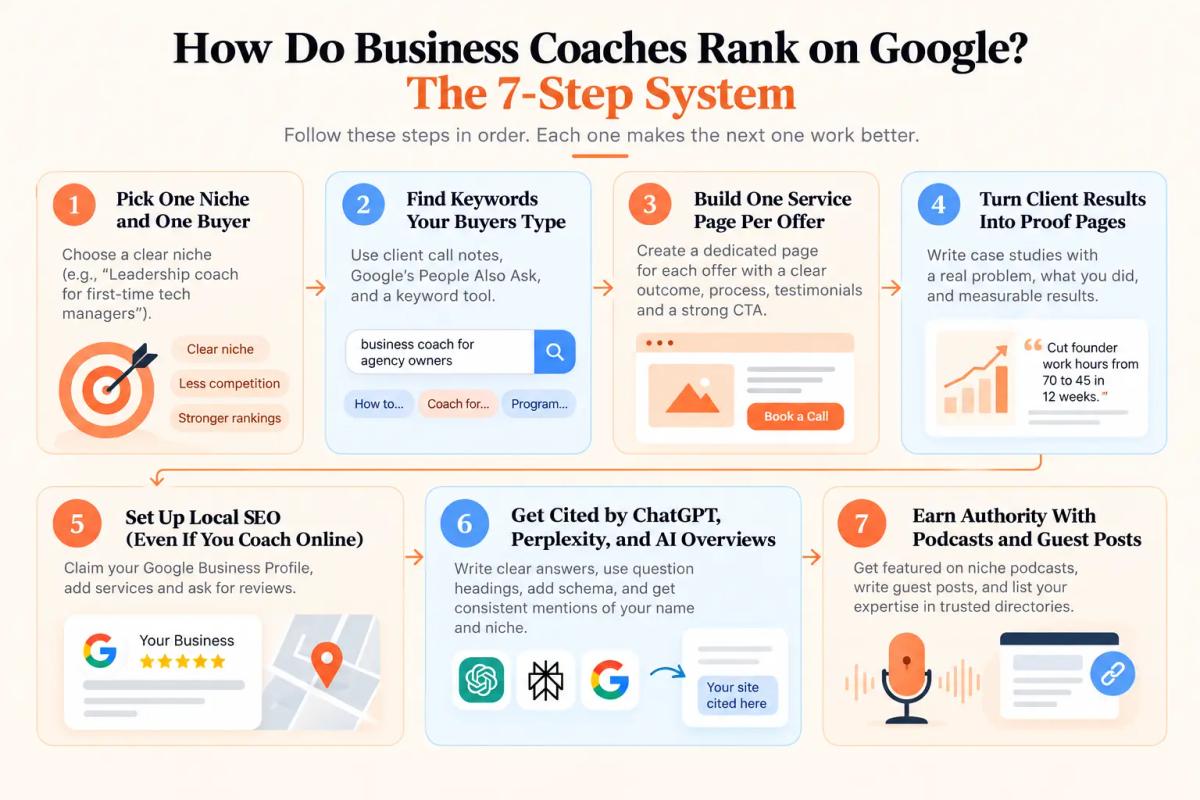
Follow these steps in order. Each one makes the next one work better.
Step 1: Pick One Niche and One Buyer
Choose a niche you can name in five words. "Leadership coach for first-time tech managers" beats "business coach" every time.
A clear niche gives you keywords with less competition. It also tells Google and AI tools exactly what you're an expert in.
Step 2: Find Keywords Your Buyers Actually Type
Your buyers rarely search "business coach." They search their problem. An HR head types "first-time manager training program." A founder types "how to delegate as a CEO."
Build your list from three sources:
- Discovery call notes. Write down the exact words clients use.
- Google's People Also Ask box. Search your core problem and note every question.
- A keyword tool. Check volume and difficulty. Start with low-difficulty terms.
Here's what strong keywords for business coaches look like:
| Generic (hard to win) | Buyer-problem (easier, higher intent) |
|---|---|
| business coach | business coach for agency owners |
| executive coaching | executive coaching for new VPs |
| leadership coach | leadership training for first-time managers |
| sales coach | sales coaching for B2B founders |
| business coaching | how to scale a service business past $1M |
| coach near me | business coach in Austin |
Group keywords by intent. "How to" terms become blog posts. "Coach for" and "program" terms become service pages.
Step 3: Build One Service Page Per Offer
Each offer needs its own page. One "Services" page listing everything won't rank for anything.
A strong business coach service page includes:
- A clear H1 with the offer and buyer ("Executive Coaching for New VPs")
- Who it's for and who it's not for
- The outcome, the process, and the timeline
- At least one named result or testimonial
- Pricing or a starting range
- One clear call to action: book a call
Quick check: Before you publish any page, run it through my free SEO checklist. It catches the title, heading, and internal link issues most coach sites miss.
Step 4: Turn Client Results Into Proof Pages
Case studies are your best ranking and selling asset. They show experience, which Google's guidance on people-first content treats as a core quality signal. Trust matters most.
Use a simple format: the client's situation, what you did, and the measurable result. "Cut founder work hours from 70 to 45 in 12 weeks" beats "helped a founder find balance."
Get written permission. Use real names where you can. Anonymous case studies work, but named ones carry more weight.
Want this system built for your coaching site? I plan the keywords, pages, and proof structure for coaches who'd rather coach than do SEO. See how SEO for coaches works.
Step 5: Set Up Local SEO (Even If You Coach Online)
Claim and complete your Google Business Profile. Many business owners still search "business coach near me" or "business coach in [city]," and local results show up above regular listings.
Add your service area, categories, photos, and services. Ask every happy client for a Google review. Keep your name, address, and phone the same everywhere online.
Local search works at scale. I used hyper-local SEO to drive 7,800+ leads for a US multi-location business. The same approach fits a coach with an office or a city focus.
Step 6: Get Cited by ChatGPT, Perplexity, and AI Overviews
Write so AI tools can lift your answer word for word. Start every section with a direct 1- to 2-sentence answer. Then add detail.
What gets a coaching site cited:
- Question-style headings that match how buyers ask
- Short answer blocks under each heading
- Named expert signals: your bio, credentials, and results on every page
- Schema markup: Person, Service, and FAQPage
- Consistent mentions of your name and niche on podcasts, directories, and LinkedIn
Go deeper on AI visibility: my GEO optimization guide shows how generative engines pick sources and how to become one of them.
Step 7: Earn Authority With Podcasts and Guest Posts
Backlinks still matter. For coaches, the easiest links come from being a guest, not from cold outreach.
- Pitch niche podcasts. Most list guests with a link on the episode page.
- Write guest posts for industry blogs your buyers read.
- Get listed in coaching directories and professional associations.
- Answer journalist requests in your area of expertise.
You don't need hundreds of links.
A few relevant ones can help a small site outrank bigger sites with stronger domain metrics.
What Is the Golden Rule of Coaching, and How Does It Apply to SEO?
A widely taught golden rule of coaching is simple: the client does most of the talking. The coach asks and listens. The client finds the answer.
Good SEO works the same way. Your content should start with the buyer's question, not your story. Answer what they asked, in their words, before you talk about your method.
Coaches who apply this to their site write pages that rank and convert. Coaches who ignore it write "About me" pages nobody searches for.
How Long Does SEO Take for a Business Coach?
Expect first leads in 3 to 6 months and steady flow in 6 to 12 months. Low-competition niche keywords move faster. Broad terms take longer.
| Timeframe | What to expect |
|---|---|
| Months 1–3 | Pages indexed, first rankings on niche keywords |
| Months 3–6 | First organic inquiries and discovery calls |
| Months 6–12 | Steady leads, AI citations, rankings for broader terms |
Speed depends on niche focus and consistency. I ranked a new blog post #1 in India and #2 in the USA in 20 days, on a 40-day-old domain. That happened because the keyword was specific and the page answered it better than anyone else.
Want to see if the time is worth it? Run your numbers through my SEO ROI calculator.
What SEO Mistakes Do Business Coaches Make?
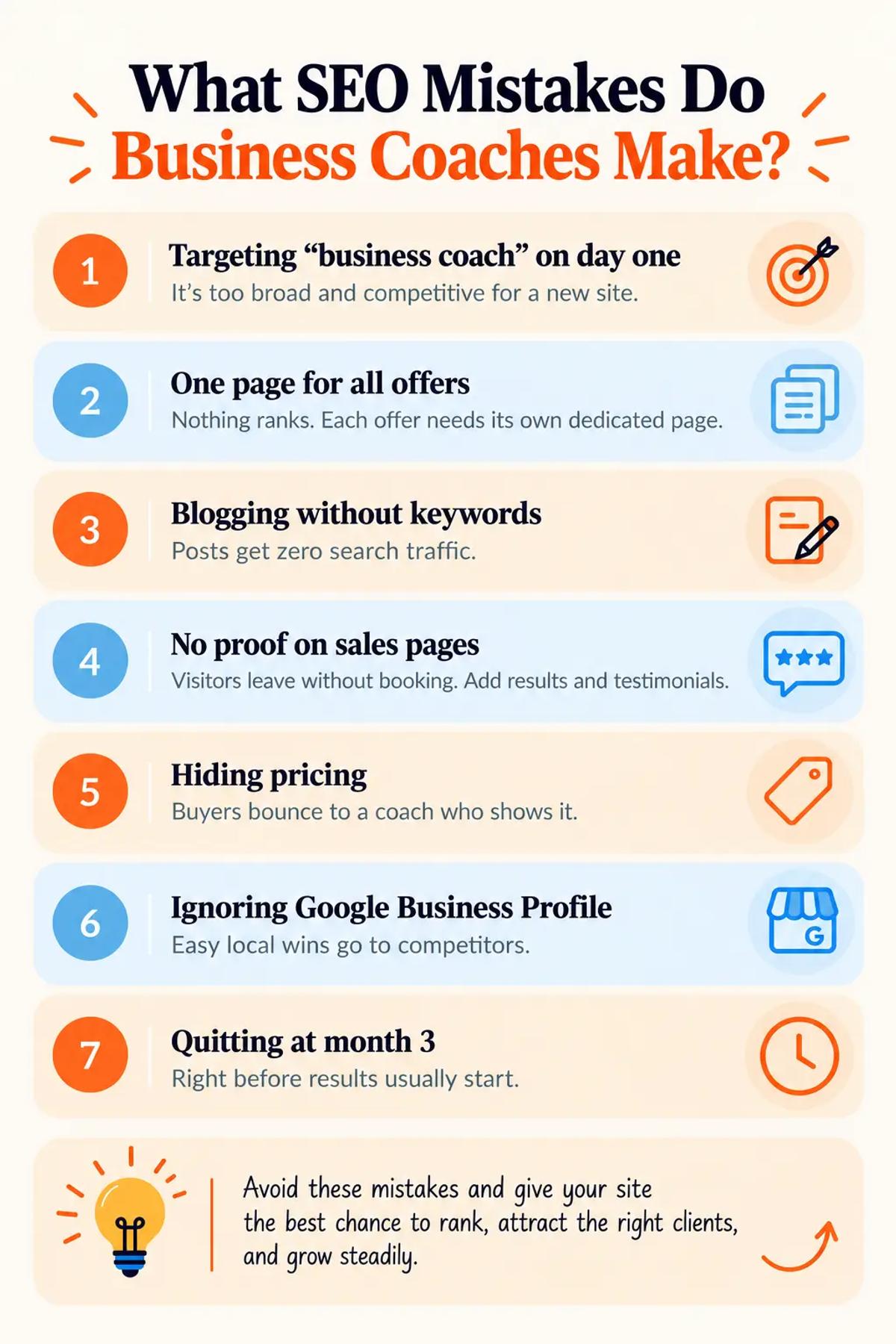
The biggest one is targeting "business coach" on day one. It's too broad and too competitive for a new site.
Other common mistakes:
- One page for all offers. Nothing ranks.
- Blogging without keywords. Posts get zero search traffic.
- No proof on sales pages. Visitors leave without booking.
- Hiding pricing. Buyers bounce to a coach who shows it.
- Ignoring Google Business Profile. Easy local wins go to competitors.
- Quitting at month 3. Right before results usually start.
If your blog is live and still quiet, this breakdown of why a blog isn't getting traffic covers the root causes.
“Bhautik took charge of the SEO strategy for Lead Harbor and achieved remarkable results in a short period. His approach covered everything from on-page optimisation to technical improvements, significantly improving our search visibility.”
Should You DIY, Hire a Fractional SEO, or Hire an Agency?
DIY works if you have 5 to 8 hours a week and a tight niche. Most solo coaches don't. Here's the quick split:
- DIY: Lowest cost, slowest results, fine for the first 3 months.
- Fractional SEO: A senior expert part-time. Strategy and execution without agency overhead. Best fit for most coaching businesses.
- Agency: More hands, higher fees. Better for coaching firms with multiple coaches and programs.
For the full breakdown on cost, control, and results, read my comparison of fractional SEO vs agency.
Ready to Get Coaching Clients From Google?
You now have the full system. The hard part is doing it consistently while you run a coaching business.
If you'd rather hand it off, I'll audit your site and map the exact keywords and pages to build first.
Image Disclosure: The images used in this article are AI-generated and are intended for illustrative purposes only.