Key Takeaways:
- Fractional SEO ($1,500–$5,000/mo) gives you senior-level strategy without a full-time salary, best for growth-stage companies between $1M and $20M in revenue.
- SEO agencies ($2,500–$10,000+/mo) handle full execution but often assign junior staff and run templated playbooks.
- In-house SEO ($6,000–$15,000+/mo) offers maximum control but only makes financial sense after organic search is already a proven revenue channel.
For most startups, fractional SEO hits the best balance of strategic depth, cost, and flexibility.
Introduction
Wrong SEO model = wasted budget and months of lost momentum.
Right model = compounding organic growth that pays for itself.
Having spent years on both sides inside agencies and now running fractional SEO engagements for startups, I can tell you there is no single "best" option.
What works depends entirely on your revenue stage, internal team, and how involved you want to be in the strategy.
Here is the breakdown, with real pricing and honest trade-offs.
What Each SEO Model Actually Means
People use these terms interchangeably. They should not. Each model operates very differently.
Fractional SEO
A part-time senior SEO strategist who integrates fully into your team: they’re in your Slack, join daily standups, and drive the SEO roadmap while working 10–20 hours per week instead of a full 40.
You are essentially hiring an SEO director at a fraction of the full-time cost.
SEO Agency
An outside team bundling strategy with execution. Content writers, link builders, technical specialists, and a project manager all wrapped into one monthly retainer.
Here is the catch, though.
The senior person who sold you the contract rarely does the day-to-day work. That falls to junior staff.
In-House SEO
A full-time hire on your payroll. They attend every meeting, know your product inside out, and focus on nothing else.
Maximum control, but also the steepest cost and the slowest ramp-up.
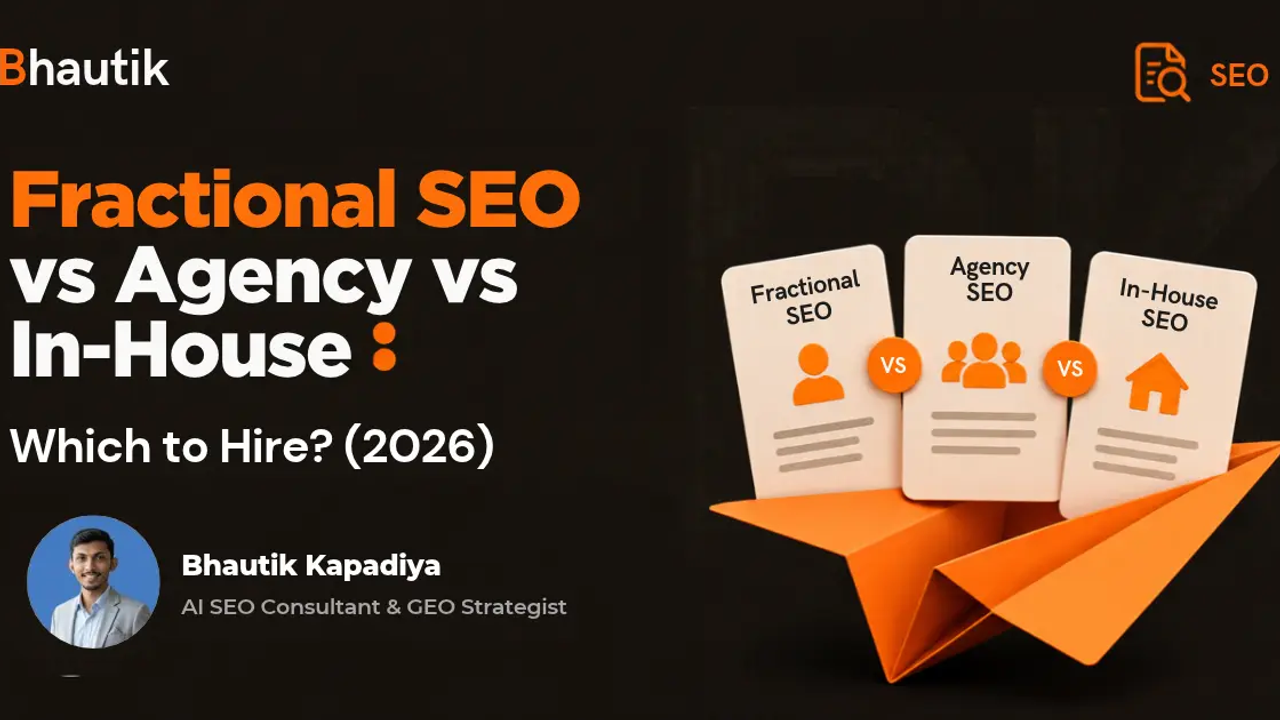
Fractional SEO vs Agency vs In-House: Side-by-Side Comparison
| Factor | Fractional SEO | SEO Agency | In-House SEO |
|---|---|---|---|
| Monthly Cost | $1,500–$5,000 | $2,500–$10,000+ | $6,000–$15,000+ (salary + benefits) |
| Strategy Ownership | Fractional expert owns it | Split between you and agency | Your hire owns it |
| Execution | Directs execution; may pair with freelancers for content | Full team handles everything | Limited by one person's bandwidth |
| Seniority Level | Senior / Director-level | Often junior for day-to-day work | Depends on your budget |
| Time to First Output | 1–2 weeks | 2–4 weeks (onboarding lag) | 60–90 days (hiring + ramp) |
| Best For | Growth-stage companies ($1M–$20M revenue) | Early-stage or execution-heavy needs | Companies where SEO already drives revenue |
| Biggest Risk | Limited execution bandwidth | Staff turnover, cookie-cutter playbooks | Single point of failure |
| AI Search (GEO/AEO) Ready | Yes if the expert specialises in it | Rare; most agencies lag on AI search | Depends entirely on the hire |
When to Hire a Fractional SEO Expert
Senior strategic thinking without the $120K+ annual salary; that is the core value proposition.
Growth-stage companies between $1M and $20M in revenue typically land here. SEO matters to the business, but no internal team runs it. Someone needs to build the roadmap, prioritise the right keywords, and direct freelancers or junior staff on execution.
Another common scenario: you tried an agency and felt disconnected from their work. A fractional hire removes that gap. You get the strategist directly, with no project manager filtering everything.
My fractional SEO clients get exactly this: one dedicated strategist who knows their product, market, and competition. Not a rotating lineup of account coordinators. You can see how fractional SEO stacks up against agencies in detail on my comparison page.
“His deep understanding of SEO has helped us achieve great results. His ability to think beyond conventional SEO tactics and implement innovative approaches has been invaluable to our success.”
When to Hire an SEO Agency
Two situations where agencies genuinely make sense.
You are early-stage and want everything handled:
No time to manage freelancers or learn the difference between crawl budget and canonical tags. You just want the entire function content, technical fixes, link building off your plate while you focus on product.
You need volume:
Twenty-plus articles per month with concurrent link building across multiple domains? A solo fractional expert cannot physically produce that output. Agencies have the headcount.
The weakness shows up in strategic depth.
A survey of 439 providers by Ahrefs puts the average agency retainer at $3,209/month. At that price, most agencies run templated playbooks and assign junior analysts to manage your account.
When to Hire In-House SEO
In-house hiring makes sense after organic search has already proven itself as a revenue driver.
You are above $5M in annual revenue. SEO contributes meaningfully to your pipeline. You want someone embedded in every sprint, every product discussion, every cross-functional meeting.
The price tag is steep. US-based SEO managers earn $80,000–$130,000 in base salary. Factor in benefits, tool subscriptions, and management time, and the annual cost climbs to $120,000–$180,000.
Below $5M in revenue, that investment rarely pencils out.
Should You Hire an SEO Agency or Do It Yourself?
Depends on what DIY actually looks like for you.
Founders who learn the basics Google Search Console, a Semrush free trial, a few solid guides can go surprisingly far on their own. Technical fundamentals and basic content direction do not require an agency.
DIY hits a ceiling, though. Keyword research, content production, technical audits, schema markup, and link building each demand consistent hours every week. By month three, most founders are buried under other priorities and SEO execution stalls.
A practical middle ground is to hire a fractional SEO expert who designs the strategy and trains your team to execute it. This gives you the strategic foundation without paying full agency fees.
Once the groundwork is in place, you can either develop the capability internally or bring in an agency later to scale content production.
Is SEO Still Worth It in 2026?
Absolutely, but the game board looks different now.
Organic search continues to account for over 50% of all website traffic. What’s changed is the number of places where that visibility occurs. Google is no longer the only player; platforms like ChatGPT, Perplexity, Google AI Overviews, and Claude now use indexed content to generate direct answers for users.
This new layer, called GEO (Generative Engine Optimisation), runs alongside traditional SEO, not against it. Businesses building for both channels today are capturing demand across every platform where their audience searches.
The real question is not whether SEO has value. It is whether your SEO strategy accounts for AI search surfaces or still treats Google as the only destination.
How Much Does Each Model Cost?
Specifics beat vague ranges. Here is what each model actually costs in 2026.
| Model | Monthly Cost | What Is Included | Watch Out For |
|---|---|---|---|
| Fractional SEO | $1,500–$5,000 | Senior strategy, roadmap, team direction, monthly reporting | Content production may require separate freelancers |
| SEO Agency | $2,500–$10,000+ | Strategy + execution (content, links, technical audits) | Tool fees extra at some agencies; junior staff on your account |
| In-House SEO | $6,000–$15,000+ | Full-time focus, deep product knowledge | Benefits, tools ($200–$500/mo), training, manager time |
| DIY | $0–$500 (tools only) | Your own time | Opportunity cost of founder hours; inconsistent execution |
Data from a Backlinko survey of 300+ SEO professionals: the most common hourly rate is $100–$150. Average monthly spend with freelancers sits at $1,349; agencies average $3,209.
Fractional SEO costs vary by scope and seniority. The common range is $1,500–$8,000 per month. My own retainers start at $1,500/month for growth-stage companies.
How to Choose the Right SEO Model for Your Business
Forget the comparison matrix for a minute. Three questions cut through the noise.
Do you have someone in-house who can carry out SEO work?
If not, your options are straightforward: hire an agency to manage everything, or bring in a fractional SEO expert and pair them with freelancers to handle content creation.
Is your revenue above $5M, with SEO already driving pipeline?
Yes? Bring someone in-house. No? Fractional or agency delivers senior-level strategy at a lower cost.
How much control do you want over the strategy?
Fractional SEO keeps you in the driver's seat. Agencies take the wheel. Neither approach is wrong; it is about fit.
Most startups and growth-stage companies I work with land on fractional. Director-level strategy, a roadmap tailored to their market, and the freedom to scale hours up or down without a rigid contract.
The Bottom Line
There’s no one-size-fits-all answer to which SEO model works best; the right choice depends on your business’s current stage.
- Little to no SEO knowledge and limited time? Go with an agency.
- Scaling quickly and need strategic direction? A fractional SEO expert is the better fit.
- Already generating significant revenue from organic search? It’s time to build an in-house role.
I offer a free channel diagnostic call for companies evaluating these options.
No sales pitch, just a clear, honest assessment of which model aligns with your stage and budget.