An AI search content optimisation checklist is a 10-step action plan that makes your pages show up inside AI-generated answers. It covers content structure, schema implementation, crawler access, topical authority, and citation tracking across ChatGPT, Perplexity, Google AI Overviews, and Gemini. If AI can't extract a clear answer from your page, it picks someone else's.
10 Steps to Get Cited by AI
- Structure every section so AI can extract it
- Write question-based headings that match real queries
- Answer the question first every single time
- Add structured data (schema markup)
- Allow AI crawlers access to your content
- Back every claim with original data and named sources
- Build topical authority through content clusters
- Keep entity and brand signals consistent everywhere
- Optimise differently for each AI platform
- Track AI citations and update content regularly
Step 1: How Do You Structure Content So AI Can Extract It?
AI models don't read your entire page top to bottom.
They break a user's question into sub-queries, search for each one separately, then pull the most relevant part of information from whatever page answers it best.
That part of information is usually a single paragraph or a short section under a heading. If your content buries the key point three paragraphs deep or spreads one idea across five sections, AI skips it.
What works for AI extraction:
- One idea per section
- Each H2 or H3 block should cover exactly one concept
- Three to five sentences max per paragraph
- Every block under a heading should make sense on its own, without needing the paragraphs before it.
- Numbered steps, comparison tables, and definition blocks all extract cleanly.
The Princeton GEO study (KDD 2024) found that structured content formats significantly outperform long-form prose for AI citation rates.
Think of your page as a collection of standalone answer blocks, not a single flowing essay.
The easier each block is to isolate, the more likely AI picks it up.
Step 2: How Do You Write Question-Based Headings That AI Targets?
Use the exact questions your audience asks as your H2 and H3 headings. AI models treat each heading as a retrieval target, a direct signal that says "this section answers this question."
Generic headings like "Content Structure" or "Technical Setup" tell AI nothing about what the section actually covers.
A heading like "How Do You Add Schema Markup for AI Search?" matches real user questions and helps the AI model understand when to use that section.
Where to find the right questions:
- People Also Ask boxes on Google for your target query
- Customer support tickets and sales call transcripts
- Reddit threads and forum discussions in your niche
- Auto-suggest results in ChatGPT, Perplexity, and Google
Every heading on this page follows this format. It's the same structure I apply across all AEO consulting projects because it works for both human readers and AI extraction.
Step 3: How Do You Answer the Question First?
Put a direct, complete answer in the first one to three sentences under every heading. No buildup. No "let's explore this topic." Just the answer.
AI models scan for the passage that most directly answers the query. If your answer sits in the fourth paragraph after three paragraphs of context, the model grabs someone else's first paragraph instead.
Before (buried answer):
Content optimisation has evolved significantly over the past several years. With the rise of AI-powered search tools, marketers need to rethink their approach. Understanding how these systems work is essential. The key is to put your answer at the top of each section.
After (answer-first):
Put your answer at the top of each section, the first two sentences under every heading. AI models extract the most directly relevant passage, and buried answers get skipped.
The second version is quotable. The first is invisible to AI.
This "answer-first" structure also fixes one of the most common reasons blog posts fail to get any traffic at all. When content buries the point, both Google and AI systems move on.
Step 4: How Do You Add Structured Data for AI Search?
Schema markup tells AI crawlers exactly what your page is, who wrote it, and what questions it answers.
Without it, AI models have to guess, and they often guess wrong or skip the page entirely.
The schemas that matter most for AI citations:
- Article schema defines the content type, author, publish date, and modified date. Critical for freshness signals.
- FAQPage schema maps each question directly to its answer. Google AI Overviews and Perplexity pull from FAQ schema frequently.
- Organisation schema establishes your brand entity with consistent name, description, and linked profiles.
- Person schema connects the author to verifiable credentials. Claude's citation system weighs author credibility heavily.
💡 Quick win:
Add FAQ blocks to every article that has a FAQ section. The schema gets generated automatically, and AI Overviews pull from it. My free SEO audit checklist includes GEO and AI readiness checks that cover this exact setup.
For non-WordPress sites, you'll need to add JSON-LD manually in the page's <head> section. Validate your markup using Google’s Rich Results Test before publishing.
Step 5: How Do You Make Sure AI Crawlers Can Access Your Content?
If AI crawlers can't reach your pages, your content doesn't exist in AI search. GPTBot (ChatGPT), ClaudeBot (Claude), PerplexityBot (Perplexity), and Google-Extended (Gemini training) each need explicit access in your robots.txt file.
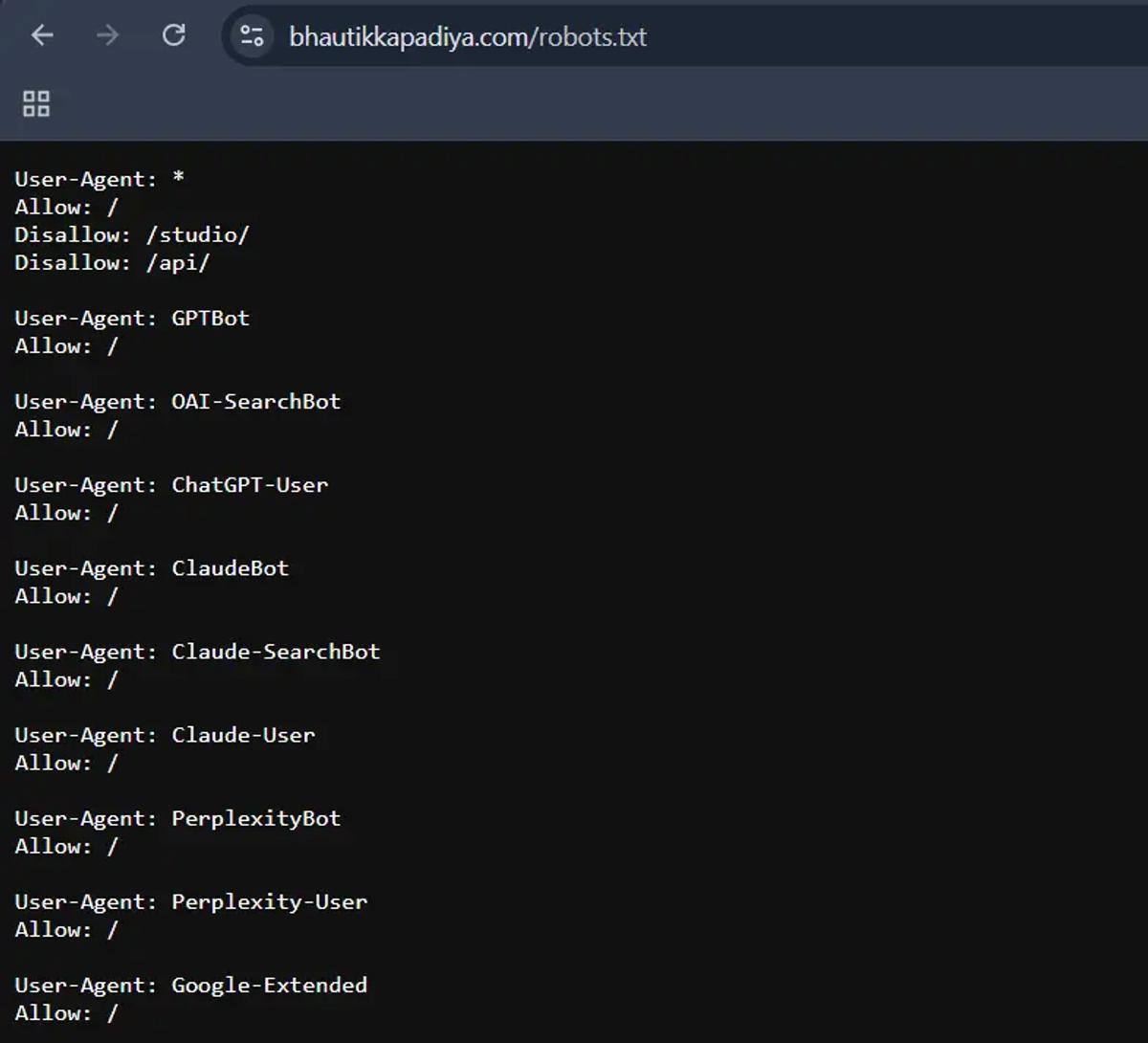
Check your robots.txt right now.
Many sites block AI crawlers by default through CMS settings, security plugins, or hosting configurations without realising it.
A robots.txt configuration that allows AI crawlers:
User-agent: GPTBot
Allow: /
User-agent: ClaudeBot
Allow: /
User-agent: PerplexityBot
Allow: /
User-agent: Google-Extended
Allow: /
User-agent: OAI-SearchBot
Allow: /
Beyond crawler access, server-side rendering matters. If your content loads only after JavaScript executes, most AI crawlers see a blank page.
Step 6: How Do You Build Citation-Worthy Content With Real Proof?
AI models prioritise content that includes specific, verifiable data over generic advice. Vague claims get skipped. Hard numbers with named sources get cited.
The Princeton GEO study confirmed this pattern: content with statistics and source citations achieved 30–40% higher visibility in AI responses than content without them.
Content that cited authoritative external sources saw up to 115% visibility improvements for pages not already in the top positions.
What makes content citation-worthy:
- Original data from your own work: Proprietary case studies, campaign results, and internal benchmarks are data AI models can't find anywhere else.
- Named sources for every statistic: Not "studies show" but "according to Seer Interactive's analysis of 25.1 million organic impressions."
- Visible author credentials: A named author with a bio and linked profiles signals expertise that AI systems factor into citation decisions.
When I scaled a CAD platform to 27.5M+ impressions with CTR growing from 2% to 5.5%, documenting those specific numbers with a transparent breakdown turned a case study into a citable proof point across AI platforms.
The content that AI can't ignore is the content no one else has. Your first-party results, your client outcomes, your tested approaches with real numbers. Publish those, and AI models will cite them because they're unique.
Step 7: How Do You Build Topical Authority With Content Clusters?
AI engines don't judge individual pages in isolation. They assess how deeply your site covers a topic through interconnected content. A single strong article is weaker than a pillar page backed by four or five supporting articles that reinforce the same expertise.
The cluster model that works:
One pillar page covers the broad topic comprehensively. Cluster articles go deep on specific subtopics.
Internal links connect everything: the pillar links to each cluster, each cluster links back to the pillar, and related clusters link to each other with descriptive anchor text.
My GEO optimisation guide works as a pillar page for the AI search optimisation topic. This checklist article is a supporting cluster piece.
Together, they signal to AI models that bhautikkapadiya.com covers AI search optimisation with depth, not just a single article.
📌 Cluster effect in practice:
For a US multi-location business, I built hyper-local content clusters across dozens of service areas. The interconnected structure, not any single page, generated 7,800+ organic leads. Topical depth compounds.
Sites that publish four or five interlinked articles on the same topic earn significantly more AI citations than sites with isolated, unconnected pages.
Step 8: How Do You Keep Entity and Brand Signals Consistent?
AI models build confidence in your brand through repeated, consistent signals across the web.
If your brand name, description, or category shifts between your website, LinkedIn, Google Business Profile, and industry directories, AI systems treat you as less trustworthy.
What to check and align:
- Brand name spelt identically everywhere (including case and punctuation)
- Company description and category consistent across your website, social profiles, and directories.
- Organisation schema on your site matching what third-party profiles say
- sameAs links in your schema pointing to your LinkedIn, social profiles, and any verified listings
This is also where third-party citations matter most. When other sites, publications, review platforms, partner pages, and directories describe your brand consistently, AI models gain confidence to recommend you.
A brand mentioned accurately across five independent sources gets cited more than one with ten mentions that contradict each other.
Step 9: How Do You Optimise for Multiple AI Platforms?
Each AI platform selects sources differently. A strategy built only for Google AI Overviews will miss ChatGPT, Claude, and Perplexity entirely.
| Platform | What it prioritises | Key action |
|---|---|---|
| Google AI Overviews | Existing Google rankings + E-E-A-T + structured data | Add FAQPage schema; strengthen on-page SEO |
| ChatGPT | Multi-source validation; Wikipedia-style depth | Get mentioned on third-party sites, forums, Reddit |
| Perplexity | Content freshness; specific dates and numbers; community validation | Update content within 90 days; include source links |
| Claude | Brave Search ranking; analytical tone; verifiable author credentials | Allow ClaudeBot; write factual, non-promotional content |
| Gemini | Consistency across Google ecosystem | Keep Google Business Profile and other Google properties updated |
The common thread: well-structured, factual content with named sources and visible author credentials performs across all platforms.
Platform-specific optimisations give you an edge on each one.
One tactic being promoted heavily for AI visibility, LLMs.txt, has zero measurable impact according to multiple studies, including Ahrefs' analysis of 137,000 sites. Focus your effort on the steps in this checklist instead.
Step 10: How Do You Track AI Search Visibility and Update Content?
AI search optimisation isn't a one-time project. AI models get updated, competitor content changes, and citation patterns shift.
Tracking your visibility and keeping content fresh is what sustains results.
How to track AI citations manually:
Write out 15 to 20 questions your buyers actually ask. Query each one in ChatGPT, Perplexity, Claude, and Google AI Overviews.
Record whether your brand appears, gets cited with a link, or gets recommended over competitors. Repeat monthly.
The metric that matters: Citation share of voice how often your brand appears in AI answers compared to competitors for the same queries.
Keeping content fresh:
- Update statistics and source links every 60 to 90 days
- Add a visible "Last Updated" date on every article
- Refresh sections when new data or industry changes emerge
- Add new FAQ questions based on emerging search queries
Content older than 90 days sees citation rates drop across AI platforms. A quarterly content audit schedule keeps your pages in the citation pool.
Why Does AI Search Content Optimisation Matter in 2026?
Search behaviour has split into two lanes. Traditional search still drives traffic through ranked links. AI search pulls answers directly from trusted pages and serves them inside the response; no click needed.
EMARKETER estimates 133 million Americans will use generative AI in 2026, reaching 39.2% of the US population. That's not a niche audience.
Nearly two in five Americans now get answers from AI tools instead of scrolling through search results.
The shift changes what "visibility" means. Ranking on page one still matters. But if ChatGPT answers your buyer's question and your brand isn't in that answer, you've lost the opportunity before a click ever happens.
| Traditional SEO | AI Search Optimization | |
|---|---|---|
| Goal | Rank in a list of links | Get cited inside the AI answer |
| Content unit | Full web page | Individual paragraphs and sections |
| Success metric | Click-through rate | Citation frequency and brand mentions |
| Key signal | Backlinks and keyword relevance | Factual accuracy and content structure |
| User behavior | Scan results, pick a link | Read the AI answer, maybe click a source |
Both disciplines share common ground. Strong traditional SEO creates the foundation that AI search optimisation builds on. The 10 steps cover what you need to do beyond standard SEO to earn AI citations.
What Are the Biggest Mistakes To Avoid?
Most failures come from the same handful of errors.
- Publishing generic content that says what every other page says: AI models gain nothing by citing your version of common knowledge. Original data, specific examples, and named case studies are what earn citations.
- Blocking AI crawlers without knowing it: Security plugins, CDN settings, and default CMS configurations often block GPTBot or ClaudeBot silently. Check your robots.txt quarterly.
- Ignoring structured data: Schema markup is the fastest path to AI citation eligibility, and skipping it means AI models have to guess what your page is about.
- Optimising for one AI platform and ignoring the rest: ChatGPT, Perplexity, Claude, and Google AI Overviews each have different source selection logic. A single-platform strategy leaves gaps.
- Never measuring AI visibility: If you're not running your target queries through AI platforms monthly, you have no idea whether your optimisation is working.
“We assigned SEO one year ago. They have executed the work very efficiently and in a highly professional manner. They follow a proper system and structured approach, and we are gradually seeing consistent growth in our results.”
AI Search Optimisation vs Traditional SEO: What's the Real Difference?
AI search optimisation builds on traditional SEO. It doesn't replace it. Strong rankings, clean technical SEO, and quality backlinks still matter because AI models often pull from pages that already rank well organically.
The difference is what comes next. Traditional SEO stops at getting you into the list of results. AI search optimisation makes sure AI systems can extract your answer, cite your page, and recommend your brand inside the generated response.
Can ChatGPT do SEO?
Not directly. ChatGPT can help with keyword research, content briefs, and technical audits. But it can't build the topical authority, original data, and entity signals that earn citations. Those require strategy, execution, and real results behind the content.
Need an expert to build your AI search strategy?
I help Founders and Business Coaches get cited in ChatGPT, Perplexity, and AI Overviews, not just ranked on Google.
Conclusion
AI search hasn't replaced Google. It's added a second layer of visibility that most businesses are ignoring.
The brands winning right now are the ones that optimise for both ranking in traditional search AND getting cited in AI-generated answers. This checklist gives you the 10 steps to do exactly that: structure your content for extraction, add the right schema, allow AI crawlers, build authority through clusters, and track your citations over time.
Start with Steps 1 through 5. They're the highest-impact changes you can make to any existing page. Then build out the remaining steps as your AI visibility baseline grows.