In coaching, the key to choosing most keywords is gut instinct. Terms like "life coach" and "business coach" are typed into content plans, written for months, and Google returns nothing.
Why?
The headline terms are overwhelming. Psychology Today, Forbes, and BetterUp own those SERPs. No solo coaching website is better than them.
This list solves that problem.
You get 100 coaching keywords, grouped by niche, intent, and realistic difficulty, that a coaching site could actually rank for.
TL;DR: Skip useless keywords like "life coach" (KD 70+). Target specific, location- and problem-based coaching keywords with KDs under 20. This list contains 100 of them, grouped by category, so you can create content based on terms that bring in paying clients, not just traffic.
Why do most coaches target the wrong keywords?
It depends on three mistakes.
The number-one priority is an obsession with volume. "Life Coach" receives over 18,000 searches per month, and directories, media outlets, and high-authority sites are all over the rankings. A new coaching website has virtually no chance.
Intent blindness is another. "What is a life coach" is a research query. "Executive coach for tech founders" is a booking signal. One brings bounce rate. The other brings revenue.
The third is to omit the specific modifier. "Career Transition Coach Austin" is much more winning for a career coach than just "career coach."
Each keyword below is organized to avoid all three traps.
How were these 100 coaching keywords chosen?
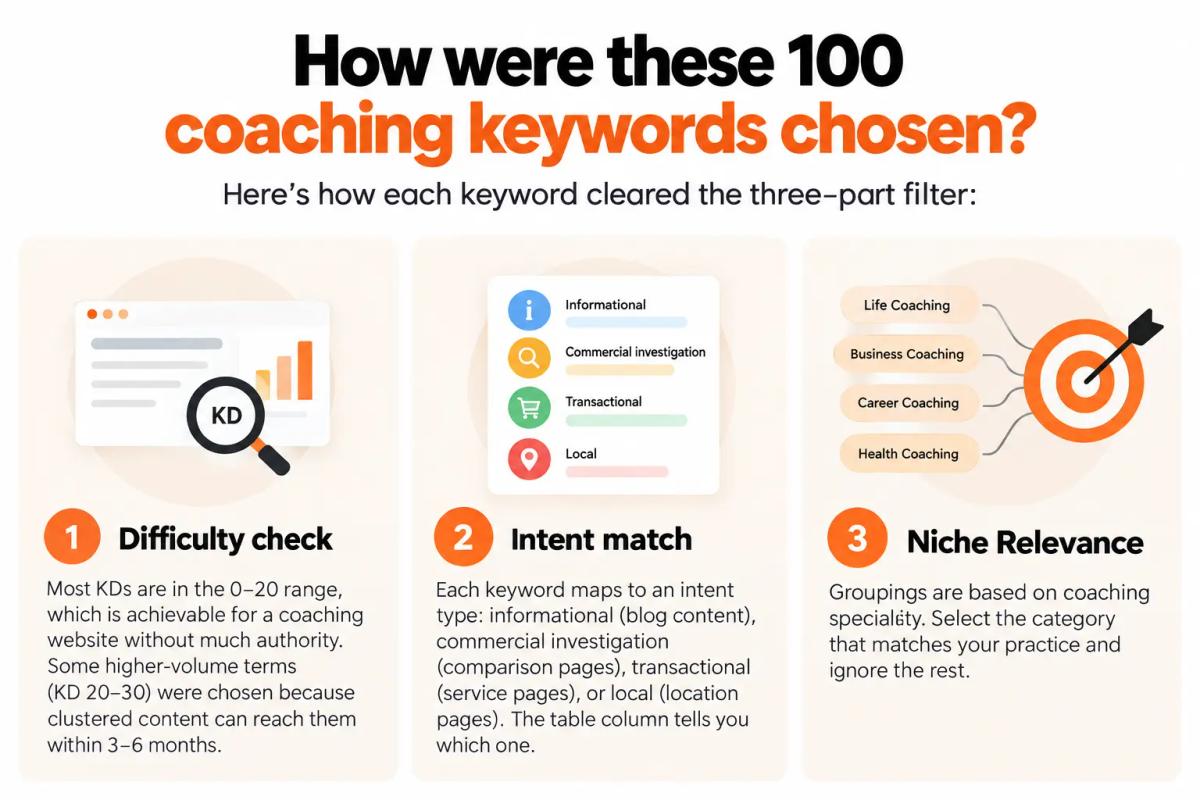
Here's how each keyword cleared the three-part filter:
Difficulty check: Most KDs are in the 0–20 range, which is achievable for a coaching website without much authority. Some higher-volume terms (KD 20–30) were chosen because clustered content can reach them within 3–6 months.
Intent match: Each keyword maps to an intent type: informational (blog content), commercial investigation (comparison pages), transactional (service pages), or local (location pages). The table column tells you which one.
Niche Relevance: Groupings are based on coaching speciality. Select the category that matches your practice and ignore the rest.
“We assigned SEO one year ago. They have executed the work very efficiently and in a highly professional manner. They follow a proper system and structured approach, and we are gradually seeing consistent growth in our results.”
Common Coaching Keywords
Applicable to every coaching niche, these help coaches build their brand and clients figure out if coaching is right for them.
| # | keyword | Intention | difficulty |
|---|---|---|---|
| 1 | Coaching Keywords | Information | Less |
| 2 | Types of coaching | Information | Less |
| 3 | Benefits of Hiring a Coach | commercial | Less |
| 4 | Online Coaching Services | commercial | medium |
| 5 | How to find the right coach | Information | Less |
| 6 | Coaching vs. Therapy | Information | Less |
| 7 | Coaching vs. Mentoring | Information | Less |
| 8 | What does a coach do | Information | Less |
| 9 | Certified Coaches Near Me | local | Less |
| 10 | Cost of coaching sessions | commercial | Less |
How to use them: Create comparative or educational blog posts targeting these phrases. Link each post to your main services page.
For example, a post on "coaching vs. therapy" could link to your coaching services page to attract readers who decide coaching is a good fit.
Life Coach Keywords
More people search for life coaching than any other coaching category. The headline term is very competitive, but the long-tail variations are very open.
| # | keyword | Intention | difficulty |
|---|---|---|---|
| 11 | Life Coach for Women | commercial | Less |
| 12 | life coach for men | commercial | Less |
| 13 | Life Coach for Young Adults | commercial | Less |
| 14 | Spiritual Life Coach | commercial | Less |
| 15 | Life Coaching Packages | transactional | Less |
| 16 | Life Coach vs. Therapist | Information | Less |
| 17 | What to expect from life coaching | Information | Less |
| 18 | Life Coach for Career Change | commercial | Less |
| 19 | Affordable Life Coach Online | transactional | Less |
| 20 | life coach for anxiety | commercial | medium |
| 21 | Holistic Life Coach | commercial | Less |
| 22 | Life Coaching for Students | commercial | Less |
| 23 | Life Coach for Self-Confidence | commercial | Less |
| 24 | Transformational Life Coaching | commercial | Less |
| 25 | Frequently Asked Questions in Life Coaching | Information | Less |
How to use them: Create a dedicated life coaching service page targeting 3–5 of these keywords. Then write supporting blog posts for the informational terms ("life coach vs. therapist," "what to expect from life coaching") and link to them from your service page.
Business Coach Keywords
Business coaching searches have a high buyer intent. People typing this phrase typically have a budget, urgency, or both.
| # | keyword | Intention | difficulty |
|---|---|---|---|
| 26 | Business Coach for Entrepreneurs | commercial | Less |
| 27 | small business coach | commercial | medium |
| 28 | Business Coach for Startups | commercial | Less |
| 29 | Business Development Coach | commercial | Less |
| 30 | Online Business Coach | commercial | medium |
| 31 | Business Coach for Women | commercial | Less |
| 32 | Startup Business Coach | commercial | Less |
| 33 | Professional Coaching Program | commercial | medium |
| 34 | How to Choose a Business Coach | Information | Less |
| 35 | The cost of a business coach | transactional | Less |
| 36 | Business Coach for Solopreneurs | commercial | Less |
| 37 | Business Strategy Coach | commercial | Less |
| 38 | Business Mindset Coach | commercial | Less |
| 39 | Business Coach ROI | Information | Less |
| 40 | Business Coach vs. Consultant | Information | Less |
Key points: Phrases like “business coach for solopreneurs” and “startup business coach” face relatively low competition while appealing to a fast-growing niche.
If you work with either audience, feature these terms prominently on your services page instead of burying them in a blog article.
Executive and Leadership Coach Keywords
High-ticket clients fall into this keyword group. C-suite executives and senior leaders search based on job titles and specific results, not generic labels.
| # | keyword | Intention | difficulty |
|---|---|---|---|
| 41 | Executive Coach for CEOs | commercial | Less |
| 42 | Leadership Coaching Program | commercial | medium |
| 43 | Executive Leadership Coach | commercial | medium |
| 44 | Leadership Coach for Managers | commercial | Less |
| 45 | Benefits of Executive Coaching | Information | Less |
| 46 | Leadership Development Coach | commercial | Less |
| 47 | C-Suite Coaching | commercial | Less |
| 48 | Executive Coach for Women | commercial | Less |
| 49 | Leadership Coach for New Managers | commercial | Less |
| 50 | Corporate Leadership Coaching | commercial | medium |
How to use them: If you serve executives, create a separate landing page for executive coaching, rather than combining it with general coaching services. Use the "Executive Coach for [title]" variation as the H2 heading on that page.
Career Coach Keywords
Economic uncertainty and hiring changes are driving demand for career coaching. These words bring you in front of people who are actively mapping out their next steps.
| # | keyword | Intention | difficulty |
|---|---|---|---|
| 51 | Career Transition Coach | commercial | Less |
| 52 | Career Coach for Mid-Career Professionals | commercial | Less |
| 53 | Career Change Coach | commercial | Less |
| 54 | Career Coach for Tech Professionals | commercial | Less |
| 55 | Career Coaching for Executives | commercial | Less |
| 56 | Job Search Coach | commercial | Less |
| 57 | Career Clarity Coach | commercial | Less |
| 58 | Resume and Career Coach | commercial | Less |
| 59 | Career Coach for Introverts | commercial | Less |
| 60 | Career Development Coaching | commercial | medium |
Health, Wellness, and Fitness Coach Keywords
Coaching and wellness overlap creates keyword gaps that standalone coaching sites can rarely cover.
| # | keyword | Intention | difficulty |
|---|---|---|---|
| 61 | Health and Wellness Coach | commercial | medium |
| 62 | Nutrition Coach Online | commercial | medium |
| 63 | fitness coach for beginners | commercial | Less |
| 64 | Weight Loss Coach | commercial | medium |
| 65 | Mindset Coach for Health | commercial | Less |
| 66 | Holistic Wellness Coach | commercial | Less |
| 67 | Wellness Coaching Program | commercial | medium |
| 68 | Health Coach vs. Nutritionist | Information | Less |
| 69 | Online Fitness Coaching Packages | transactional | Less |
| 70 | Stress Management Coach | commercial | Less |
Relationship and Dating Coach Keywords
Organic competition for relationship coaching terms is much lower than for therapy-related searches. Growing niche, slimmer SERP.
| # | keyword | Intention | difficulty |
|---|---|---|---|
| 71 | Relationship Coach for Couples | commercial | Less |
| 72 | Dating Coach for Men | commercial | medium |
| 73 | Dating Coach for Women | commercial | Less |
| 74 | Relationship Coach Online | commercial | Less |
| 75 | Marriage Coach vs. Therapist | Information | Less |
| 76 | Breakup Recovery Coach | commercial | Less |
| 77 | Communication Coach for Couples | commercial | Less |
| 78 | Dating Confidence Coach | commercial | Less |
| 79 | Relationship Coaching Packages | transactional | Less |
| 80 | attachment style coach | commercial | Less |
Location-Based Coaching Keywords
Adding a city or region to any coaching keyword immediately reduces the competition. These are the easiest wins on this list.
| # | keyword | Intention | difficulty |
|---|---|---|---|
| 81 | I have a life coach | local | medium |
| 82 | Business Coach [Your City] | local | Less |
| 83 | Career Coach in [your state] | local | Less |
| 84 | Executive Coach [Your City] | local | Less |
| 85 | Coaching Services Near Me | local | Less |
| 86 | Wellness Coach [Your City] | local | Less |
| 87 | Leadership Coach Near Me | local | Less |
| 88 | The best coach in [your city] | local | Less |
| 89 | Online coaches accept clients | commercial | Less |
| 90 | Virtual Coaching [Your State] | commercial | Less |
How to use them: Create a location-specific landing page for the city you work in. Include your city name in the H1, meta title, and at least two H2 headings. Add your Google Business Profile and embed a Google Map, if applicable.
Coaches who work virtually also benefit from local pages; clients often prefer someone in their time zone.
Long-tail and problem-based keywords
Problem-based coaching keywords have the highest conversion rates. The searcher already has a defined struggle and is actively looking for someone who can address it.
| # | keyword | Intention | difficulty |
|---|---|---|---|
| 91 | How to Find a Coach for Accountability | Information | Less |
| 92 | Coach for Imposter Syndrome | commercial | Less |
| 93 | Coaching for Overwhelmed Entrepreneurs | commercial | Less |
| 94 | Work-life balance coach | commercial | Less |
| 95 | Coaching for people pleasers | commercial | Less |
| 96 | The coach will help me set boundaries | commercial | Less |
| 97 | ADHD Coach for Adults | commercial | Less |
| 98 | Coaching for Burnout Recovery | commercial | Less |
| 99 | Career Confidence Coach | commercial | Less |
| 100 | How to Find Coaching Clients From Google | Information | Less |
Key Takeaway: Problem-based keywords perform better than generic terms for two reasons. First, the searcher already knows they need help; they're not browsing, they're buying. Second, there's less competition because most coaching sites only target niches.
A blog post targeting "coaching for overwhelmed entrepreneurs" can rank within a few weeks on a new site.
How to choose the right keywords from this list
Not all 100 keywords apply to your work. Use this filtering process:
Step 1: Match your niche
If you're a career coach, skip the relationship section. If you provide executive coaching, focus on that table, as well as problem-based terms that match your clients' challenges.
Step 2: Check the Intent column
Transactional and commercial keywords go to service pages. Informational keywords become blog posts. Local keywords get dedicated location pages.
Step 3: Start with low-complexity keywords
Sort your shortlist by difficulty. Publish content for the easiest terms first. Initial rankings build domain authority, making even difficult keywords easier to find over time.
Step 4: Group keywords into clusters
Don't create a separate page for each keyword. Group similar terms: "business coach for startups" and "startup business coach" should be on the same page.
Do you already have a coaching website but aren't getting traffic? Start with one. A free SEO checklist to find gaps.
What about AI search visibility?
Clients now find coaches not just through traditional search results, but also through ChatGPT, Perplexity, and Google's AI Overviews.
These AI tools provide direct answers to coaching questions. When your content has short paragraphs, clear answers under each heading, and proper schema markup, AI platforms can identify your site as the source.
The practice of optimizing for these citations is called Generative Engine Optimization (GEO). This works alongside traditional SEO.
Two things increase your chances of getting a site:
Write your answer above each section. AI systems place the first 2–3 sentences under the heading. Hide your answer in paragraph four, and it will be ignored.
Add structured data. FAQ schema, author schema, and article schema send clear signals about the topic of your content. The AI Search Checklist explains each step.
Do you want to create a keyword strategy for your coaching speciality?
I help coaches build SEO and GEO systems that consistently bring in client leads from Google and AI search without relying on social media.
How do coaches create content around these keywords?
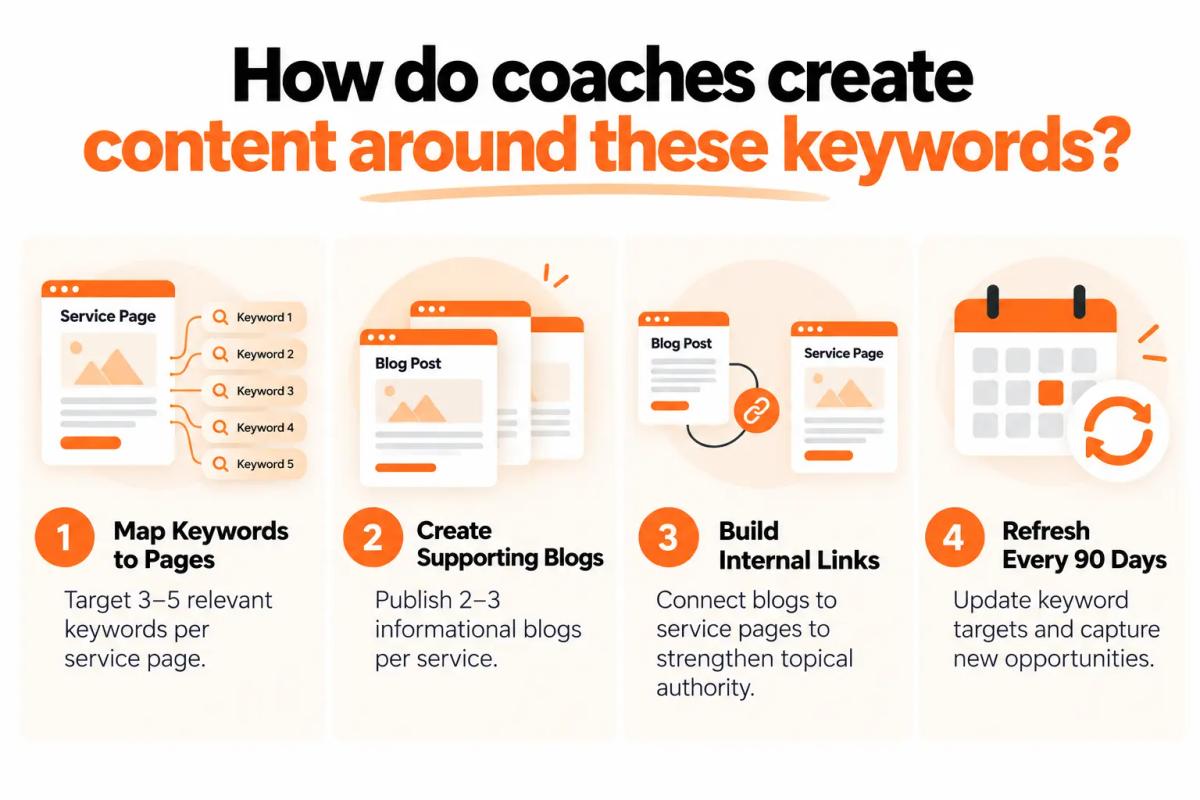
Creating a keyword list is the starting point. Converting it into rankings requires a content plan.
Map keywords to pages: Each of your services gets a dedicated page. Choose 3–5 related keywords from this list for that page. Your primary keyword will go in the H1 and meta titles. Secondary keywords will become H2 headings.
Write supporting blog posts: For each service page, publish 2–3 blog posts targeting informational keywords. For example, a business coaching service page would be supported by posts like "How to Choose a Business Coach" and "Business Coach vs. Consultant."
Link everything together: Each blog post links to a related service page. This internal linking pattern signals to Google that your service page is an authority on the topic on your site. SEO checklist to verify your on-page structure before publishing.
Update every three months: Search trends change. New long-tail phrases emerge. Review your keyword targets every 90 days and add new content about any new opportunities.
What is a good tagline for coaching?
Your tagline should include your primary coaching keyword and your main promise. It's not a slogan; it's a positioning statement that works for both search engines and prospective clients.
Strong coaching taglines follow this formula: [Outcome] + [Audience] + [Method/Differentiator].
Example:
● "Career Clarity for Mid-Career Professionals Through Structured Coaching"
● "Business Growth Coaching for Solopreneurs: Strategy, Not Motivation"
● "Executive Leadership Coaching for First-Time CTOs"
Keep it under 10 words. Make sure it includes a keyword you want to rank for. Place it in your homepage H1 or site description.
Want to rank in AI search results too? Traditional SEO gets you on Google. GEO gets you on ChatGPT, Perplexity, and AI Overviews. AEO Consulting Services covers both, so your coaching site appears everywhere clients are searching.