GEO (Generative Engine Optimisation) is how you get your brand cited inside AI-generated answers from ChatGPT, Claude, Perplexity, and Google AI Overviews, not just ranked in a list. ChatGPT now serves 900M+ weekly active users, 60% of searches end without a click, and AI Overviews cut organic CTR by 61%. But brands that get cited earn 120% more clicks per impression.
Each AI platform selects sources differently: ChatGPT values multi-source corroboration, Claude uses Brave Search and rewards analytical content, Perplexity prioritises freshness and Reddit presence, and Google AI Overviews build on existing rankings. This guide covers 8 proven GEO tactics backed by the Princeton/KDD 2024 research, platform-specific strategies, and a free 30-minute audit you can run today.h, platform-specific strategies, and a free 30-minute audit you can run today.
Introduction
Your content ranks on the first page of Google. But when a potential buyer asks ChatGPT the same question, your brand doesn't appear. Your competitor does.
That's not an SEO problem. It's a GEO problem. And it's quietly costing businesses real revenue every single day.
Here's the scale of this shift: ChatGPT now serves 900 million weekly active users and crossed 1 billion monthly active app users in June 2026, making it the fastest app in history to reach that milestone.
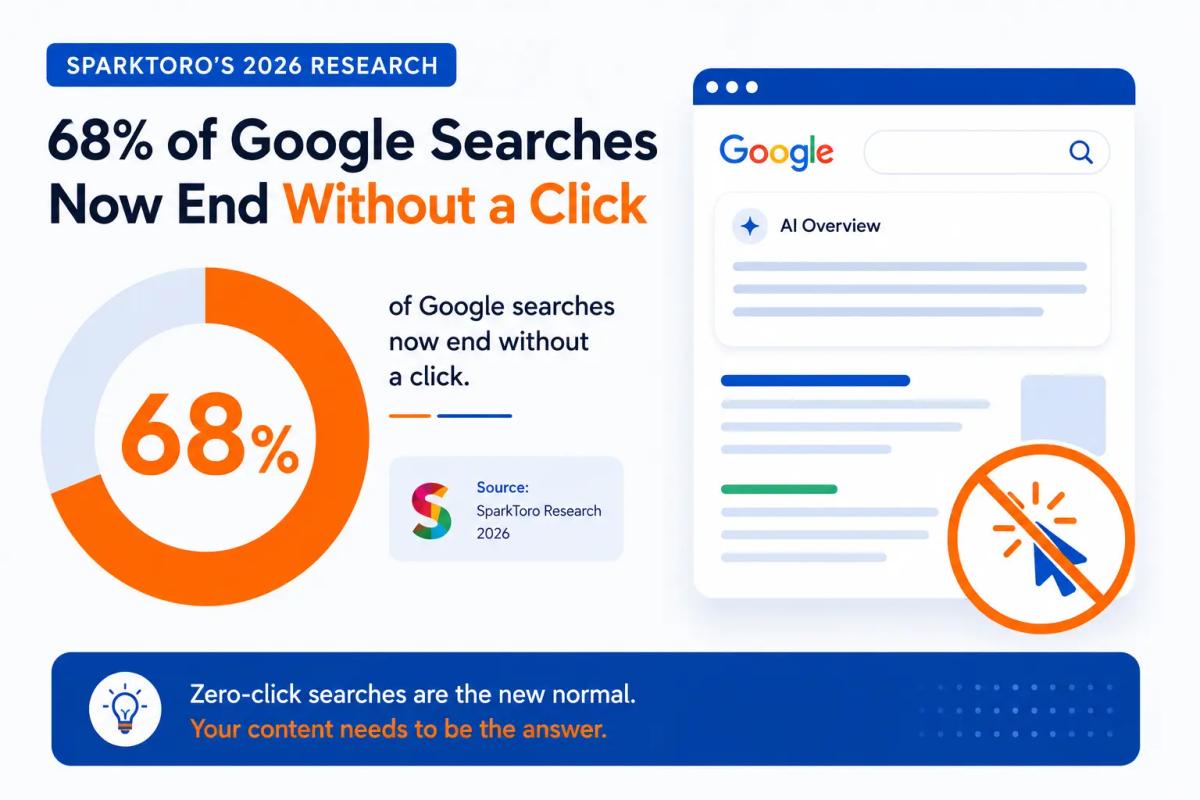
Meanwhile, Bain & Company's research found that 80% of consumers now rely on AI-generated results for at least 40% of their searches, and roughly 60% of searches end without the user clicking through to any website.
Your customers are getting answers. They're just not getting them from you.
This guide covers GEO optimisation from the ground up: what it actually is, how each major AI platform selects its sources differently, the exact tactics backed by peer-reviewed research, and a free 30-minute audit you can run today. Real data, real tactics, no theory.
What is GEO optimisation?
GEO (Generative Engine Optimisation) is the practice of structuring your content so that AI platforms ChatGPT, Claude, Perplexity, and Google AI Overviews cite it directly inside their generated answers.
With traditional SEO, you're competing for a spot in a list of ten blue links. GEO skips the list entirely - your content gets pulled directly into the answer the user actually reads."
The term was formally defined in a research paper by Princeton University, Georgia Tech, IIT Delhi, and the Allen Institute for AI, presented at ACM SIGKDD 2024. The researchers tested 10,000 queries across multiple generative engines and found that targeted GEO techniques can increase content visibility in AI responses by up to 40%.
That's not a theoretical figure. It's peer-reviewed and reproducible. And by 2026, it's the difference between brands that exist in AI search and those that don't.
Why Every Business Owner Should Pay Attention Right Now?
The numbers make the urgency clear.
ChatGPT reached 900 million weekly active users in February 2026, more than doubling its 400 million user base from the same period in 2025 (OpenAI / TechCrunch). By May 2026, the ChatGPT app crossed 1 billion monthly active users globally (Reuters / Sensor Tower).
Bain & Company's consumer research found that about 60% of searches now terminate without users clicking through to another website. Organic web traffic has dropped an estimated 15–25% across many sectors as a direct result.
When an AI Overview appears on Google, organic CTR drops by 61% (Seer Interactive, September 2025 study of 25.1 million organic impressions across 42 organisations). But here's the critical detail: brands cited within AI Overviews earn 120% more clicks per impression than uncited brands on the same query.
Being cited doesn't just protect your traffic. It amplifies it.
The Princeton GEO study found that pages ranked around position 5 experienced a 115% increase in visibility after GEO optimisation, meaning the biggest gains go to brands that aren't already dominating but have quality content worth citing.
The window to build AI citation authority is open right now. Every month you wait, competitors accumulate citation history that AI models will favour going forward.
How Does Each AI Platform Select Its Sources?
Not all AI platforms are the same engine with a different logo. Each one has a distinct retrieval system, different trust signals, and specific content preferences that determine whether your page gets cited or ignored. Here's how the four major platforms actually work under the hood;
How does ChatGPT select sources?
ChatGPT pulls from two pools when answering a question. First, everything baked into its training data up to the knowledge cutoff. Second, live web browsing that retrieves pages in real time. For most queries in 2026, both kick in simultaneously; the model blends what it already knows with what it finds right now.
In browsing mode, ChatGPT breaks your question into multiple smaller sub-queries; researchers call these "fan-out queries" It searches each one separately, then synthesises the results into a single response.
What ChatGPT favours:
Research shows that Wikipedia accounts for a significant portion of ChatGPT's top-cited sources for factual questions. That tells you exactly what the model values: structured content, neutral tone, clear definitions, and high information density. You can't become Wikipedia, but you can write with that same level of precision and objectivity.
ChatGPT also cross-checks your brand against independent sources before citing it. If someone on Reddit recommends your tool, an industry blog references your case study, and a content creator links to your research, that pattern of independent validation raises your citation probability far more than publishing another article on your own blog.
This isn't a nice-to-have. It's table stakes. Bain & Company's research found that for nonbranded queries, over 90% of what LLM engines cite comes exclusively from third-party sources. Your own website barely registers unless other people are already talking about you.
How does Claude AI select sources?
Claude is the hardest AI platform to earn citations from. But that difficulty is strategically valuable: brands that earn Claude citations almost always appear in ChatGPT and Perplexity too. Crack Claude, and you've largely cracked AI search.
The fact most GEO guides miss: Claude uses Brave Search as its retrieval backbone. If your content doesn't rank on Brave, Claude won't find it regardless of how well you rank on Google.
Anthropic runs three separate crawlers, and understanding each one matters:
ClaudeBot indexes and evaluates content quality for Claude's search results. Blocking this in your robots.txt removes you from Claude-powered search entirely.
Anthropic-AI crawls for model training data. You can block this independently without affecting your search visibility in Claude.
Claude-User is the third crawler - it activates when someone pastes a URL directly into a Claude conversation.
Worth noting: all three of Anthropic's crawlers respect robots.txt, which is more than you can say for every AI crawler out there.
What Claude favours:
Anthropic built Claude around a Constitutional AI framework, which means the model actively filters for content that's helpful, harmless, and honest. Getting the facts right isn't enough. If your tone reads like a sales page's pushy claims, vague attributions like "studies show," or copy that's clearly pitching rather than informing, Claude will skip you even when your data is accurate.
The filter is tonal, not just factual. Write like an operator sharing what works, not a marketer trying to close
Author authority matters significantly. When an Article schema explicitly declares an author entity with verifiable credentials, citation confidence increases substantially compared to plain text with no author markup. A named, credible author isn't optional for Claude visibility.
What Claude avoids: vague source attributions ("a recent study found..."), content that contradicts third-party validation of the same claims, and anything that reads as promotional rather than informative.
How does Perplexity select sources?
Perplexity places strong emphasis on content freshness, recent updates, and sources validated through community discussions and trusted references.
Reddit and forum content account for a significant portion of Perplexity's citation sources, making community presence the single biggest signal for Perplexity visibility. Content published within the last 90 days gets strong preference. External citations to authoritative sources with specific dates and verifiable numbers perform significantly better than general claims.
Practical implication: Getting your brand discussed in active, high-quality Reddit threads and relevant forums is direct Perplexity optimisation. This isn't social media marketing; it's a core GEO strategy for this specific platform.
How does Google AI Overview select sources?
If you're already doing SEO well, AI Overviews are the most straightforward platform to crack. Google doesn't reinvent the wheel here; it takes your existing ranking signals, E-E-A-T authority, and structured data, then runs an AI synthesis layer on top to decide what gets quoted in the overview box.
The practical upshot: pages that already rank well organically and use FAQPage and Article schemas have a clear head start. You're not building from scratch. You're making your existing SEO work harder."
The most important data point: Seer Interactive's 2025–2026 analysis of 5.47 million queries across 53 brands found that pages cited inside AI Overviews receive 120% more clicks per impression than uncited pages. Being cited makes your standard organic results perform dramatically better, not just the AI answer.'
Need Help Getting Cited in AI Search?
Most businesses optimise for Google but completely miss ChatGPT, Claude, and Perplexity. As an AEO consultant, I audit your content across all four AI platforms, identify exactly where you're invisible, and build a citation strategy based on how each platform actually selects sources.
8 GEO Optimisation Tactics That Work in 2026
These eight tactics come from the Princeton GEO research, cross-referenced with patterns I've seen across 14+ client projects. They're ordered by impact - start with the first three, and you'll cover the highest-leverage changes before touching anything technical.
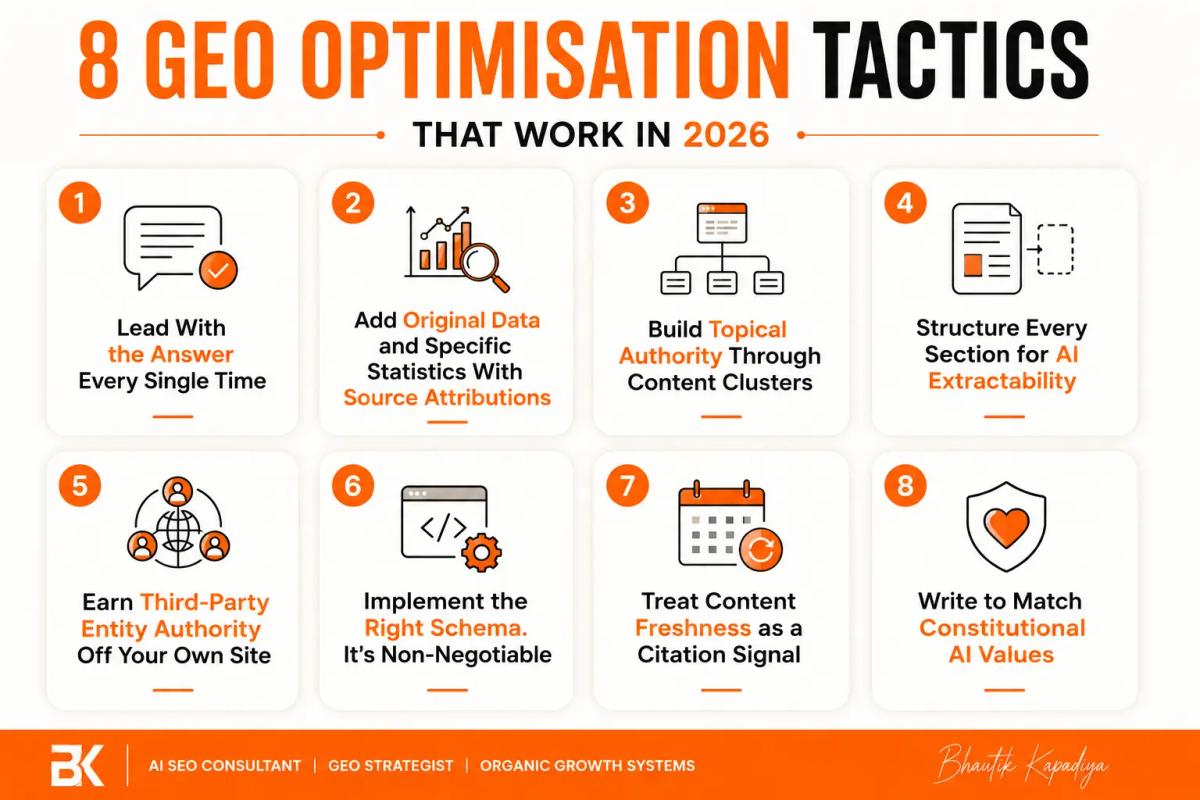
1. Lead With the Answer Every Single Time
AI models use Retrieval-Augmented Generation (RAG) to extract specific passages from your content. They don't read your full article. They extract the most relevant chunk.
That means your opening 40–80 words under every H2 must stand completely alone as a direct answer. No build-up. No preamble. Answer first, explain second.
The Princeton GEO research found that adding statistics to these opening answer paragraphs improved visibility by 41%, and citing external sources improved visibility by up to 115% for content that wasn't already in position one. This is the highest-impact single change you can make to any existing piece of content.
Why Most Blog Content Fails at This
The answer-first format isn't just a GEO tactic; it's the fix for one of the most common reasons blogs get zero traffic. When your content buries the answer under 300 words of context, both Google and AI systems skip it. I broke down all 10 root causes (including content-intent mismatch) here: Why Your Blog Isn't Getting Traffic.
The structure that works:
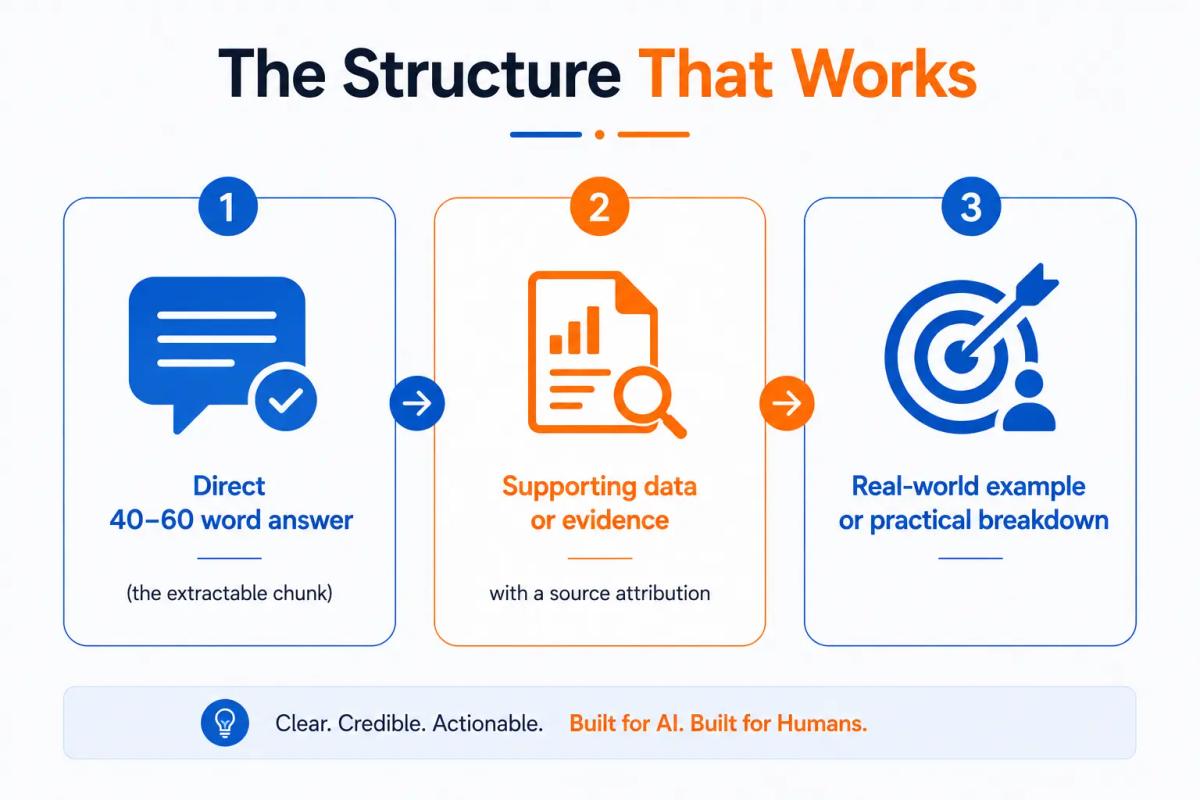
Start with a direct 40–60 word answer - this is the chunk AI will extract. Follow it with hard data and a named source. Then ground it with a real-world example or practical breakdown that proves the point.
This is the format I use across all content I build for clients. It's the same approach that helped me rank a brand-new, 40-day-old website to position one in India and position two in the USA within 20 days: structured content designed to be cited, not just ranked.
2. Add Original Data and Specific Statistics With Source Attributions
AI models look for "anchors" when generating answers: hard numbers, specific percentages, and verifiable data points that give the response substance. Generic claims get skipped.
The Princeton GEO study confirmed this: content with statistics and source citations achieves 30–40% higher visibility in AI responses than content without them.
The practical rule: every claim needs a number, and every number needs a traceable attribution.
Don't write: "AI search is growing fast." Write: "ChatGPT crossed 900 million weekly active users in February 2026, more than doubling its user base in 12 months (OpenAI / TechCrunch)."
The second version is quotable. The first is invisible to AI models.
Your strongest move is to publish proprietary data from your own work. Original case studies, internal benchmarks, and campaign results with specific numbers are content AI engines cannot find elsewhere, so they cite them.
When I generated 7,800+ leads for a US local business using hyper-local SEO across multiple locations, documenting that specific result with a transparent breakdown made it a citable proof point, not just a claim on a services page.
3. Build Topical Authority Through Content Clusters
AI engines don't evaluate individual pages in isolation. They assess your overall depth on a topic through your interconnected content architecture. A single strong article is weaker than a pillar page surrounded by five supporting cluster pages that all reinforce the same expertise.
The content cluster structure for GEO:
One pillar page covering the broad topic (this article is an example). Cluster pages for each sub-topic, for example, "How to optimise for Perplexity," "Claude citation tracking," or "GEO metrics and Share of Model tracking." Multi-directional internal linking: the pillar links to each cluster, each cluster links back to the pillar, and related clusters link to each other.
Topical Authority in Action
For a US multi-location local business, I built hyper-local content clusters targeting each service area with dedicated landing pages, supporting blog content, and cross-linked location hubs. That system generated 7,800+ organic leads not from one viral post, but from deep, interconnected topical coverage across dozens of pages. See the full approach: Local SEO Case Study.
This semantic web signals deep topical expertise to both Brave's ranking algorithm (critical for Claude) and each AI platform's source selection logic.
4. Structure Every Section for AI Extractability
Because AI platforms break queries into sub-queries before searching, your content needs to answer the smaller questions, not just the broad head term.
Say someone asks ChatGPT, "How do I get my brand to appear in AI search results?" The model doesn't search for that exact phrase. It breaks it apart, running separate searches for things like "GEO optimisation tactics 2026," "how ChatGPT chooses sources," and "AI citation best practices."
Each of those sub-queries could land on a different section of your article. But here's the catch: that only works if each section answers its own question completely, without depending on the paragraphs before it.
Structural rules that improve AI extractability:
Use question-forward H2 and H3 headings"How Does ChatGPT Select Sources?" performs better than just "ChatGPT."
Write every section as 75–300 words covering one idea completely. Use numbered steps for process content and comparison tables for options; structured formats are significantly easier for AI to parse and cite accurately.
Use semantic HTML<article>, <main>, and <section> Tags so AI crawlers can isolate your content from navigation, ads, and sidebar elements cleanly.
5. Earn Third-Party Entity Authority Off Your Own Site
Here's the trust signal most businesses miss: AI engines don't trust what you say about yourself. They trust what others say about you.
Bain & Company's data puts a number on this: even when an LLM does mention a brand by name, over 60% of the cited content still comes from third-party sources - not the brand's own site.
For nonbranded queries (which are most of what your buyers search), third-party sources account for more than 90% of citations. What others say about you carries far more weight than what you say about yourself.
This isn't a PR recommendation. It's a core GEO requirement.
Tactics that build third-party entity authority:
Guest articles in industry publications relevant to your niche. Expert quotes in other creators' content, podcasts, and interviews. Genuine presence in Reddit and forum discussions where your buyers ask questions. Consistent, accurate business information across directories (NAP consistency matters for entity recognition). Wikipedia citations where you have verifiable, notable information.
The goal: when an AI model cross-references a claim about your expertise, it should find multiple independent sources confirming it, not just your own website.
6. Implement the Right Schema. It's Non-Negotiable
Structured data is not optional for GEO in 2026. It's how AI crawlers verify content credibility and reliably extract structured information.
The schema you need for every article:
Article schema with an explicit author entity. This single change significantly improves Claude's citation confidence compared to unattributed content.
FAQPage schema on every FAQ section. AI Overviews and Perplexity frequently extract FAQ schema verbatim.
Person schema for the author, linked to verifiable profiles (LinkedIn, personal website).
Organisation schema for your brand entity.
HowTo schema for any step-by-step instructional content.
Technical requirements alongside schema:
Allow GPTBot, ClaudeBot, PerplexityBot, and BingBot in your robots.txt. Blocking any of these removes you from that platform's citation pool.
Implement server-side rendering (SSR) or pre-rendering. AI crawlers need content immediately available, not JavaScript-rendered after page load.
Use semantic HTML structure throughout (<article>, <main>, <section>).
Not Sure Which AI Tools Fit Your Workflow?
Schema validators, citation trackers, and AI crawl checkers there are dozens of tools out there, and most blogs just list them without context. I built a free AI Tool Recommender that matches the right tools to your specific use case and budget.
7. Treat Content Freshness as a Citation Signal
Content over 90 days old sees citation rates drop sharply across AI platforms. Pages updated within the last 30 days receive significantly more citations than older material on the same topic.
This isn't just about slapping a new date on existing content. It's about visible update signals that AI crawlers can detect.
The freshness system that works:
Display a visible "Last Updated: [Month Year]" date at the top of every article. Update statistics, data points, and source links every 30–90 days. Add an explicit version note when you make significant additions, for example, "Updated June 2026: added Ahrefs 137K-site analysis and Google's official LLMs.txt guidance." Set recurring calendar reminders for your top-performing pages.
For any content strategy focused on AI visibility, freshness maintenance isn't an editorial nice-to-have. It's a citation maintenance task.
8. Write to Match Constitutional AI Values
This tactic targets Claude specifically, but it improves content quality across every platform.
Claude's citation selection is shaped by Anthropic's Constitutional AI (CAI) framework. Content must be helpful, harmless, and honest, not just technically accurate. Promotional tone, exaggerated claims, and vague source attributions are actively deprioritised even when the underlying facts are correct.
What this means practically:
Write in an analytical, operator tone, not a marketing tone. Acknowledge nuance and limitations; don't present everything in absolutes. Use specific, traceable source attributions: not "a recent study found" but "according to Seer Interactive's September 2025 analysis of 25.1 million organic impressions."
Present multiple perspectives on contested topics rather than one-sided advocacy. Let your results speak"I helped a UK B2B brand reach 3,911 organic leads using this system" is a factual, verifiable claim. It's far stronger than "I'm an expert in this field."
Claude rewards specificity and verifiability. Every vague claim is a failure of trust.
What Doesn't Work for Claude (or Any AI Platform)
One tactic being heavily promoted for AI visibility is LLMs.txt, a plain-text file that supposedly helps AI systems understand your site. Four independent studies, including Ahrefs' analysis of 137,000 sites, found it has zero measurable impact. Google's June 2026 guidance confirmed it doesn't affect rankings or AI Overviews. Full breakdown: Why LLMs.txt Is Overhyped.
How to Run a GEO Audit in 30 Minutes (Free)
Before building anything new, establish your baseline. You need to know where your brand stands across each AI platform before you can measure improvement.
Step 1: Write out 15–20 questions your buyers ask when researching your category.
Step 2: Query each one in ChatGPT, Claude, Perplexity, and Google AI Overviews separately.
Step 3: Note which brands appear in each answer. Record whether yours appears, in what position, and with what sentiment.
Step 4: Track the structure and tone of content that gets cited. Pay attention to which formats each platform prefers: definitions, numbered lists, data tables, or Q&A pairs.
Step 5: Calculate your Share of Model (SoM) baseline: citation frequency ÷ total queries tested, per platform.
“Bhautik took charge of the SEO strategy for Lead Harbor and achieved remarkable results in a short period. His approach covered everything from on-page optimisation to technical improvements, significantly improving our search visibility.”
Run this audit monthly. The changes you see month over month are your GEO performance data.
Tools that automate AI citation tracking:
- Otterly.ai monitors brand mentions across AI platforms (starts at $39/month).
- Semrush Enterprise AIO tracks visibility across ChatGPT, Google AI Mode, and Perplexity.
- Ahrefs Brand Radar tracks brand mentions in AI Overviews.
- SE Ranking tracks citations in ChatGPT and Perplexity by target keyword.
GA4 custom dimensions can capture AI referral traffic from known user agents: ChatGPT-User, PerplexityBot, Claude-Web.
The metric that matters most is Share of Model: how often your brand appears in AI-generated responses compared to competitors, for your target queries, across all relevant platforms. This is the GEO equivalent of keyword rankings.
Platform-by-Platform Quick Reference
ChatGPT Primary signal: Wikipedia-style authority and multi-source corroboration. Unique requirement: brand mentioned across forums and third-party sites. Avoid thin content with no data or citations.
Claude Primary signal: Brave Search ranking plus Constitutional AI alignment. Unique requirement: ClaudeBot access allowed, author credentials verified, facts traceable. Avoid: promotional tone, vague attributions, salesy language.
Perplexity Primary signal: content freshness and Reddit/forum presence. Unique requirement: published within 90 days, external source links included. Avoid: outdated statistics, no timestamps, no update signals.
Google AI Overviews Primary signal: existing Google rankings plus E-E-A-T signals. Unique requirement: FAQPage schema, strong organic authority. Avoid: pages with thin content or no structured data.
Key Takeaways
GEO optimisation is the practice of structuring content so AI platforms cite it inside their generated answers, not just rank it in a list.
ChatGPT now serves 900 million weekly active users and crossed 1 billion monthly active users in June 2026. The audience is massive and growing.
Roughly 60% of searches end without a click. When an AI Overview appears, organic CTR drops by 61%. But brands cited in AI Overviews earn 120% more clicks per impression.
Each AI platform has different citation logic. ChatGPT values multi-source corroboration. Claude uses Brave Search and rewards analytical, verifiable content. Perplexity prioritises freshness and Reddit presence. Google AI Overviews layer AI synthesis on top of traditional ranking signals.
The Princeton GEO study found that adding statistics improves AI visibility by 41%, and citing sources improves visibility by up to 115% for content not already in position one.
Schema markup, topical authority, content extractability, and third-party entity signals are the foundations of GEO in 2026, not shortcuts or hacks.
Start with the free 30-minute audit: 15 questions, 4 platforms, and your Share of Model baseline. Then build from there.
Ready to Build Your GEO System?
I've helped businesses generate 7,800+ leads, scale brands from zero to 3,911 organic leads, and rank new sites to #1 in 20 days, all through organic systems. If you want a GEO + SEO strategy built for your specific niche, let's talk.