
- 01
Location keyword map
179 target termsEach location got its own list of searches, such as "car wash near me" and "full service car wash [city]", mapped to its own page.
- 02
Google Business Profile
Calls + directionsMatching name, address and phone, the right categories, fresh photos, Q&A and a steady review response routine.
- 03
Citations and local links
Per-location authorityConsistent listings in local directories and links from local sites, built separately for each location.
- 04
Location landing page
Bounce rate -12.35%Rebuilt for a driver on a phone: services, reviews, a clear call or booking button and GA4 tracking.
Case study · California, USA · Multi-location
Local SEO case study: 7,800+ leads for a multi-location car wash.
Several car wash locations, all losing the map pack to local rivals. I ranked each location as if it were the only one, then made every page and profile easy to call, book or drive to.
5.0/5 on TopmateTop 5% expert14+ projects in the US, UK & India
map-pack.viewillustrative
- Form leads
- 5,100+
- Calls + directions
- 2,600+
- Total leads
- 7,800+
7,800+
Leads from organic search and Google Business Profile
5,100+
Website form submissions, tracked in GA4
2,600+
Calls and direction requests from Google Business Profile
138 / 179
Target local keywords on Google page 1
The short version
More locations ranked.
More people at the counter.
This local SEO case study follows a multi-location car wash in California. Each location got its own keyword map, landing page, Google Business Profile and local links. The result: 7,800+ leads from organic search and Google Business Profile (5,100+ form submissions and 2,600+ calls and direction requests), 138 of 179 target keywords on Google page 1 and a 12.35% lower bounce rate.
It is the same system I run as part of my local SEO services for multi-location and service-area businesses.
- Client
- Multi-location car wash
- Market
- California, USA
- Main levers
- Location pages, Google Business Profile, local links
- Lead types
- Form submissions, calls, direction requests
- Measured in
- GA4, Google Search Console, GBP insights
Where it started
Good washes,
lost on the map.
The business relied on walk-ins and word of mouth. Local search sent some visitors, but almost none of them turned into a booking or a call.
- Problem 01
Crowded map results
Established local car washes held the map pack with strong profiles and long review histories.
- Problem 02
Visitors who didn't act
Location pages had high bounce rates. The content didn't match what a nearby driver wants to know.
- Problem 03
Traffic without leads
People reached the site, but few filled in a form or called. There was no clear next step on the page.
- Problem 04
Weak local signals
Name, address and phone details didn't match across the web, citations were thin and the Google Business Profiles were half done.
Where the leads came from
Two doors in.
Both opened by local search.
A local lead doesn't always visit the website. Two in three filled in a form on a location page. One in three called or asked for directions straight from the Google Business Profile.
7,800+leads from organic search and GBP
5,100+
Website form submissions
Booking and enquiry forms on the location pages, tracked as GA4 conversions.
2,600+
Calls and direction requests
Taps on call and directions inside the Google Business Profiles, from GBP insights.
Counted: organic form submissions (GA4) and GBP calls and direction requests. Not counted: leads from the client's own paid ads.
The playbook
One location, four layers.
Repeated for every site.
Google ranks a location, not a brand. So each branch got the full stack on its own, instead of one shared page trying to rank everywhere.
of US consumers used AI tools for local business recommendations in the past year, up from 6%.
local pack ranking factor, according to local search experts: your primary Google Business Profile category.
Same four layers, repeated for every location
Keyword coverage
179 local searches.
138 of them on page 1.
Each square is one high-intent local search, like a service plus a city. Orange means it reached Google page 1.
77%of target local keywords on page 1
Page 1 (138) Not yet (41)Keyword names withheld to protect the client.
The proof
How to read
the client's GA4 report.
A raw dashboard proves little if you don't know where to look. The numbered marks show what matters.
Google Analytics 4 · User acquisition
Client data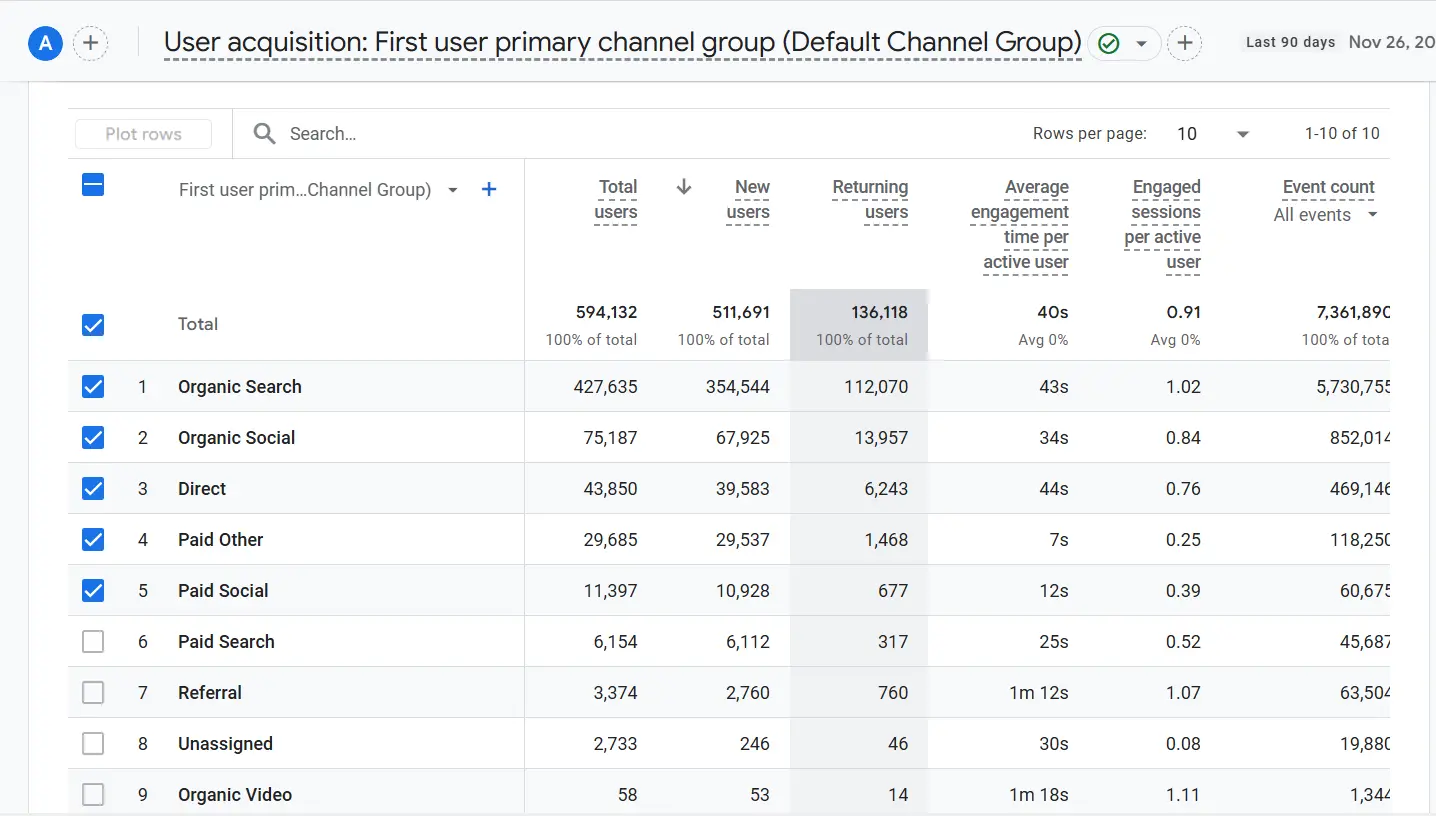
- 1
What the report shows
GA4 User acquisition by first channel, last 90 days. Every channel the site gets visitors from, in one table.
- 2
Organic search leads the mix
427,635 of 594,132 users came from Organic Search in this window. That is about 72% of all users.
- 3
Organic visitors engage more
1.02 engaged sessions per active user from organic, against 0.25 to 0.52 for the paid channels.
- 4
Paid traffic is listed, not counted
The client ran its own ads. Those rows stay in the screenshot, but the 7,800+ leads only count organic forms and GBP actions.
What you can copy
Three lessons
for any business with a storefront.
- 01
Treat each location as its own business.
One generic page for every branch ranks for nothing. A page, a profile and a keyword list per location is what moved 138 terms onto page 1.
- 02
The profile is the shop window.
2,600+ leads never touched the website. They called or asked for directions straight from Google Business Profile.
- 03
Ranking is half the job.
The forms only filled once the pages gave a nearby driver a reason and a button. That is where the 5,100+ form leads came from.
“Most multi-location brands build one great page and hope it ranks in every city. It won't. Each location has to earn its own spot on the map.”
Is this you?
When this playbook fits,
and when it doesn't.
A good fit if
- You run two or more locations or serve several cities
- Competitors take the map pack while your profiles sit half done
- People visit your location pages but rarely call or book
- Your name, address and phone differ across listings
Probably not a fit if
- You need calls this week (paid local ads are faster for that)
- You only sell online with no service area
- You want guaranteed map pack positions by a fixed date
FAQ
Questions about
local SEO results.
Something else on your mind? Email me at hello@bhautikkapadiya.com.
More results
Other industries,
same measured approach.
Your turn
Nearby customers are searching.
Does every location show up?
Book a free 15-minute call. We'll look at your map rankings, your Google Business Profiles and where each location is losing leads.
I take on a limited number of retainer clients at a time.