
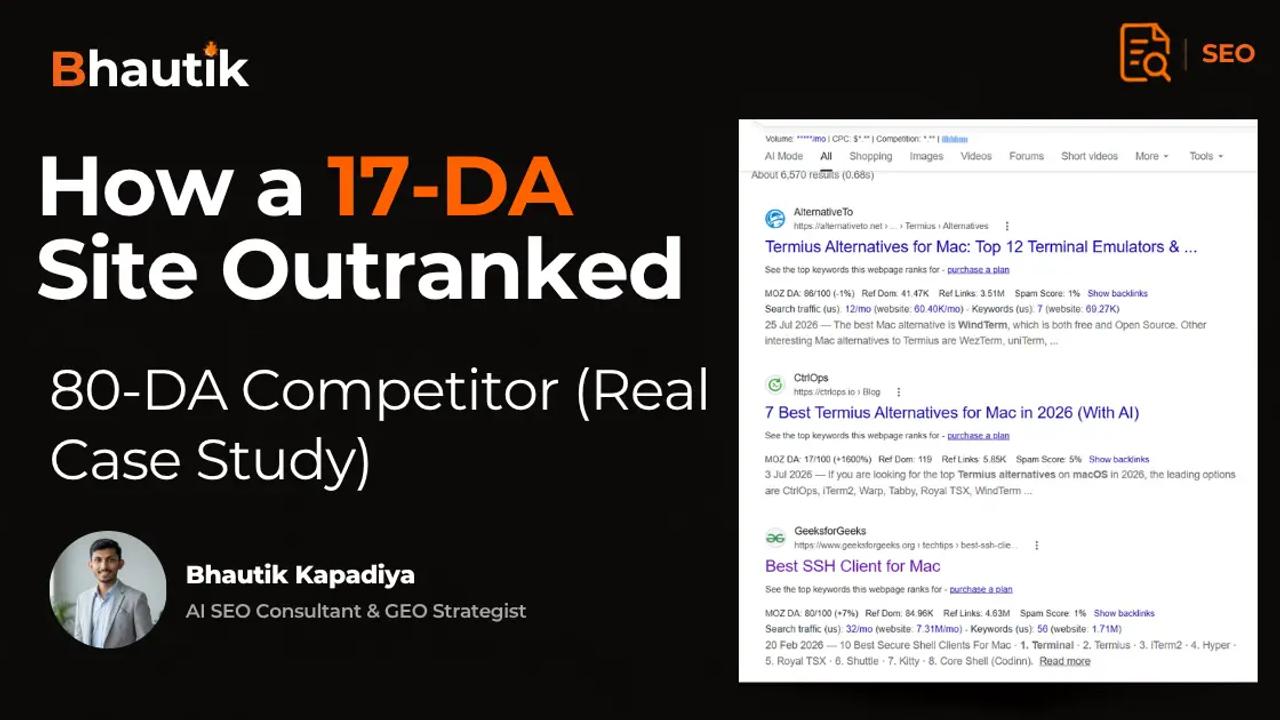
Key takeaways
A website with a DA of around 17 for a commercial keyword in the software space outperformed competitors with a DA of 80+. The domain was only ~5 months old and had been SEO active for ~4 months. We targeted only 6 keywords, achieved strong results for 5, and built visibility not only in Google organic results but also in Google Images, AI Overview, and Confusion. The strategy was focused on deep local authority, not content volume.
Case Study Snapshot
| Metric | Our website | Primary competitor |
|---|---|---|
| Domain Authority (Moz) | ~17 | ~80 |
| Referring domains | ~119 | ~84,000+ |
| Reference links | ~5,800 | ~4.6 million |
| Domain age | ~5 months | Founding years |
| Active SEO period | ~4 months | Ongoing |
| Targeted keywords | 6 | Hundreds |
| Keywords with good results | 5 out of 6 | |
| Search focus | Commercial purpose (software specific) | Comprehensive tech coverage |
| AI search visibility | Presented (Google AI Overview, Google Images, Confusion) | Not optimized for AI search |
The above includes only verified data from SERP snapshots and Moz Toolbar analysis. Estimated values are marked.
Introduction
DA 80 had over 84,000 referring domains on the website. Millions of backlinks. Accumulated authority over the years.
We had a website with a domain authority of about 17. The domain was about five months old. We had been actively working on it for about four months. And for a commercially valuable keyword in the software sector, the lower-authority website was ranking higher.
Not by accident. Not by luck. By strategy.
The point of this case study is not to argue that domain authority doesn’t matter. It does. But for a particular search query, authority alone doesn’t determine the winner. Relevance, objective alignment, content depth, and local focus can create real competitive advantages even for a new domain with almost no link profile.
Here's exactly what happened and what made the difference.
The SEO assumption I wanted to test
There's a belief in SEO that's repeated so often that it seems like a law of physics: big authority wins.
High DA. High DR. Thousands of referring domains. Years of indexing history.
These things make it almost impossible to promote a website, especially for commercial keywords where the stakes are high.
And in many cases, that's true. Authority signals are important. Google takes into account the strength and trustworthiness of a domain when determining rankings. I'm not here to make another argument.
But here's a question I wanted to answer with a real project:
What happens when a lower-tier website becomes dramatically more relevant for a particular query than an established competitor?
Not in theory. In practice.
The competitor we were up against had a DA of around 80. Over 84,000 referring domains. Millions of backlinks. A website generating millions of monthly visits. This was no weak competitor; it was one of the most recognised tech publishers on the internet.
Our website? DA 17. About 119 referring domains. About 5,800 backlinks. Five months old. Hardly any errors in comparison.
On paper, there was no competition.
We didn't try to beat the entire website.
This is the part where most people misunderstand competing with high-authority websites.
We never tried to outdo that DA 80 competitor in its entire field. That would have been absurd. They had thousands of indexed pages covering hundreds of tech topics. We had a handful of pages covering one.
Instead, we narrowed the competition down to a single battlefield.
A commercial topic in the software sector. Six carefully selected keywords. A tightly connected content ecosystem.
The traditional approach to SEO often looks like this: Publish 100 articles on 100 different topics, scatter keyword targets all over the place, hope some of them stick. It’s a volume play. And with enough authority and enough time, a volume play works, which is exactly why high-DA sites tend to win that game.
We couldn't play that game. So we couldn't play.
Our approach was different:
6 strategic keywords → Deep research on each → Competitor-by-competitor SERP analysis → Connected content covering the entire topic → Internal relevance → Brand visibility → AI search optimization
The logic was simple. If we can't compete on domain-wide authority, we can compete on topic-specific relevance. A website doesn't have to be strong everywhere.
It needs to be the strongest answer for the specific query the searcher just typed.
Key insight:
A high DA gives a website an advantage. It doesn't automatically give every page on that website the best result for every query.
Step 1: We did keyword research differently
Most keyword research stops at two columns: monthly volume and keyword difficulty.
I've run so many projects that I know that volume and KD are starting points, not endpoints. For this project, we went a lot deeper.
For each of the six target keywords, we mapped out:
Key question: Every meaningful variation.
Researchers demonstrated the purpose of the comparison, feature-based search, problem-oriented search, and platform-specific requirements.
We studied what terminology the target audience actually used, not what SEO tools suggest, but what real users typed when evaluating options.
We also looked at the decision process behind each keyword.
When someone searches for the keyword “alternatives” in commercial software, they’re not browsing randomly. They have a specific problem. They’re probably using an existing product. They want to compare options based on features, price, platform compatibility, and workflow fit.
Understanding that decision process led us to change the structure of each piece of content.
We didn't create a keyword list as big as we could find. We created the most complete understanding of what the searcher really wants when they type each query.
Keyword research isn't just about finding keywords. It's about understanding the language, intent, and decision process behind them.
Any person who From the beginning of SEO strategy, this is the step that separates a generic content calendar from a truly competitive strategy. If you skip this depth, then every page you publish will have that gap.
Step 2: We analysed the ranking competitors one by one
Opening up the SERP for our primary keyword, I wasn't just interested in seeing who was in first place.
I wanted to understand why Google decided that each ranking page deserved its spot. And, more importantly, where the gap was.
For each competitor ranking on page one, I studied:
What was actually covered on the page. What was left out. Which research objectives did it satisfy, and which objectives did it leave unfulfilled? How deeply did the material go into each subtopic? What elements were mentioned on the page? What comparisons did it make? What questions did it answer?
How was the information organised? How likely was the reader to trust that page? And critically, what information appeared repeatedly in the top results, and what original information was not being provided?
The DA 80 competitor published a list-style article. It covered the topic. But it was broad. It covered the category as part of its vast tech content library, not because the website had deep expertise in that particular topic. The coverage was adequate, not authoritative.
Many other competitors had a similar approach: surface-level lists created by large publishing houses covering thousands of topics. Decent content, but not created with the kind of specificity that a user comparing software options really needs.
The gap appeared there.
SERP gap analysis, which studies not only what is ranking but what is missing from the rankings, is one of the most widely used competitive research techniques in SEO. It’s not enough to match what competitors have written.
You need to identify what they didn't cover, what they did wrong, and what you can explain more clearly.
The result of this analysis gave us a content blueprint that was structurally different from everything on page one.
Step 3: We created a local authority around a specific commercial topic
Local authority is one of the SEO concepts that is more often explained in theory than implemented in practice.
Here's what this project actually looked like.
Instead of publishing a single article and hoping to rank it, we built a small but tightly connected content ecosystem around a business topic. Every page on the website reinforced the same topic. Internal linking naturally connected related concepts.
The terminology was consistent. The coverage was so complete that the user could learn everything they needed without even leaving the site.
We answered the primary business question. We included related questions: feature comparisons, platform requirements, pricing considerations, workflow differences. We anticipated that someone would search further after reading our main content. And we answered those questions before the user had to go back to Google.
In practice, this is a relevant authority: not to publish 100 articles on a broad topic, but to be truly, measurably useful around a specific topic.
DA 80 competitor?
He had an article on this topic. One. Surrounded by thousands of articles about completely different tech topics. His domain authority was huge, but his local focus on this particular topic was small.
We had six pieces of content. All focused. All connected. All reinforcing the same topical signal.
Content authority is not the quantity of content. It is depth + relevance + coverage + usefulness.
If you are working with a new or low-authority domain, this is a practical way to proceed. You can't outpublish a DA 80 competitor. But you can out-focus them. I wrote about how Local depth applies to SaaS SEO; the same principle applies to virtually every niche.
Step 4: We wrote for the first user
This seems obvious. It's not.
Most SEO content is written to satisfy a checklist: hit the target word count, add the primary keyword X times, add a few headers, put in some bullet points. The result is content that technically covers the topic but doesn’t actually help anyone.
For this project, the content needed to be a little more specific. It had to help the reader make a decision.
When someone searches for the keyword “alternatives,” they don’t want a Wikipedia-style overview. They want answers to real questions: Which option fits my workflow? What are the real tradeoffs? What does each tool do well, and where does it fall short? What has changed recently?
So the content addressed those questions directly. We included practical comparisons. We provided honest explanations, including limitations where they existed. We organised the information in a way that made it easy to scan, compare, and make decisions.
The idea here is to get information. If the reader can get the same answer from ten other pages, then publishing another generic article adds no value.
Google has now become very good at recognising when a page actually provides something new and when it is simply re-presenting something that already exists.
For our project, the information benefited from:
More in-depth feature analysis than any competing page. More current information; many competitors had outdated content. Practical recommendations based on real use cases rather than generic feature lists. Honest evaluation of each option rather than promotional roundups.
This type of content earns clicks, earns time on page, and gains engagement signals that strengthen rankings over time.
Step 5: We worked not only on links, but also on brand mentions
Traditional link building is simple: get other websites to link to you. The more links, the more authority, the better rankings.
But there's a parallel signal that's become increasingly relevant: brand mentions. Not necessarily hyperlinked; just the association of your brand name with a specific topic in contextual, relevant spaces.
For this project, we intentionally worked to make the brand visible in places where the target audience was already discussing the topic. Relevant community discussions. Third-party references. Contextual mentions in places where someone evaluating software options would naturally look.
I'm not claiming that the ranking was achieved solely because of brand mentions. But local relevance, content quality, and Strong entity signals contributed to the broad pattern of visibility that Google recognises.
The shift from “build links” to “build recognisable entity presence” is one of the defining changes in modern SEO. Especially for new domains that can’t compete on raw backlink counts, establishing an entity identity around a specific topic creates a different kind of authority that grows over time.
Are you struggling to compete with high-authority competitors? The answer is usually not more backlinks; it’s better SERP research, deeper local focus, and smarter content positioning. I break down competitive SERPs for clients every week.
Step 6: We optimised for more than just blue links
Here's what separates modern SEO from the SEO playbook most people are still following.
Ranking in the traditional ten blue links is just one level of search visibility. In 2026, there are many surfaces where your content can appear, and most websites are only optimising for one of them.
For this project, we deliberately structured the content and the broader strategy to appear across a variety of search surfaces.
Google AI Overview
We've structured the content in a way that makes key answers immediately distinguishable. Short answer blocks under clear headings. Direct comparisons formatted in a way that AI models can analyse. Structured data that helps Google understand the content type and the entities involved.
The goal wasn't to "game" AI overviews. It was to make our content so clearly organised and directly useful that an AI system retrieving information from the web would naturally consider it a strong source.
Google Images
Visual assets were important for this topic. Users evaluating software want to see what the interface looks like. We created useful, relevant images with descriptive context and appropriate surrounding content. This gave additional visibility through Google Image results, which many competitors in this SERP did not consider.
AI discovery
I said this is Generative Engine Optimisation; it is not a separate branch from SEO. It is an extension of the same goal: to be the most useful, most cited source for a given query, regardless of which system is responding.
Ranking is no longer the only visibility metric. Track where your brand appears in Google Organic, AI Overview, Google Images, Perplexity, and other answer engines.
I’m not claiming that we achieved guaranteed placement in AI Overviews or Perplexity. What I’m saying is that we intentionally optimised for these surfaces, tracked visibility between them, and saw results that a traditional “rank for keywords” approach would have completely missed.
Result (What we Achieved)
After about four months of active work, the results looked like this.
A website with DA 17, approximately 119 referring domains and about 5,800 backlinks, outranked a competitor with DA 80, over 84,000 referring domains and millions of backlinks. For a commercially valuable keyword.
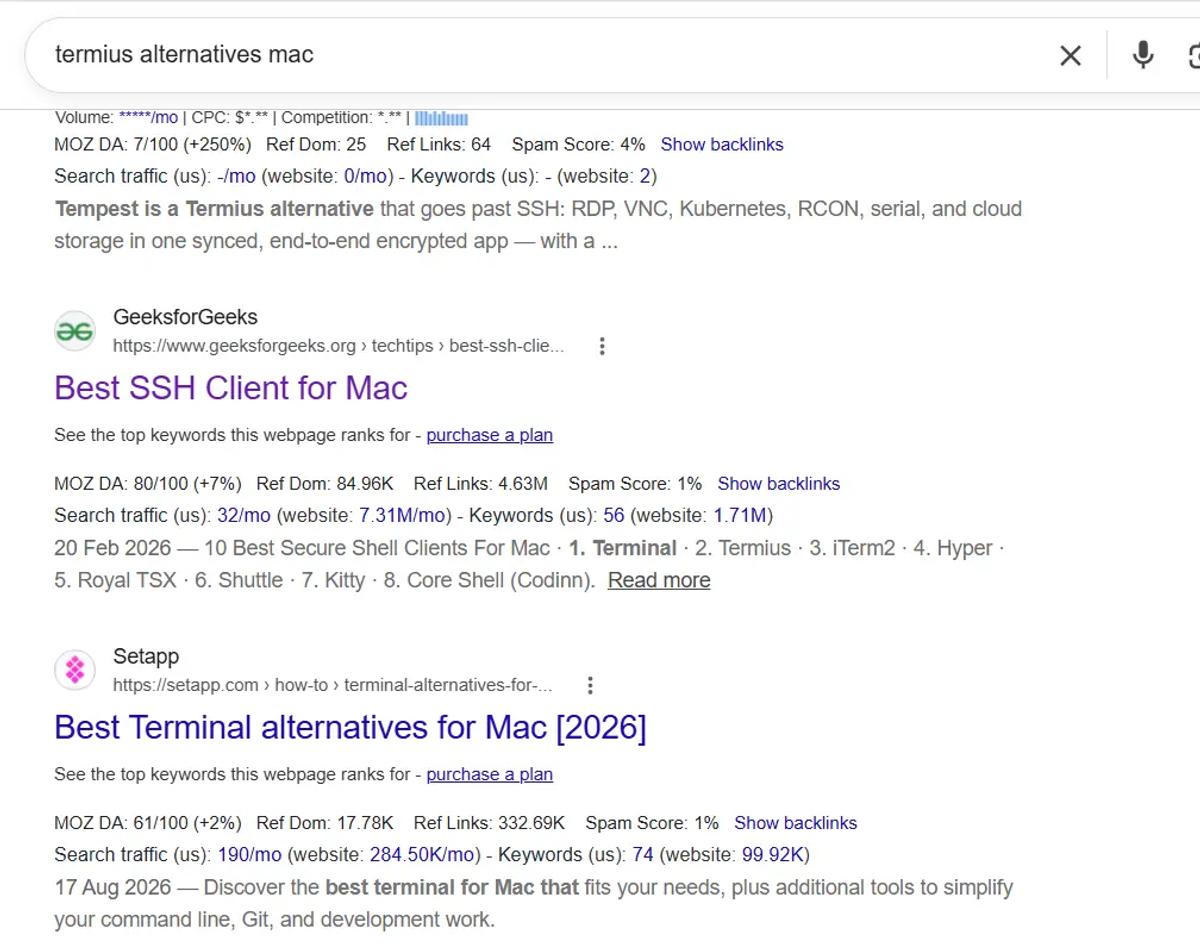
The DA 80 competitor publisher was no slouch. It was one of the most recognised tech reference sites on the internet, driving millions of monthly visits to its domain.
Our website targeted six primary keywords on this business topic. Of those six, we achieved strong ranking visibility for five.
Visibility went beyond traditional organic rankings. We tracked the brand’s presence in Google Image results, AI Overview, and Perplexity. The content was appearing on multiple surfaces, not just the ten blue links.
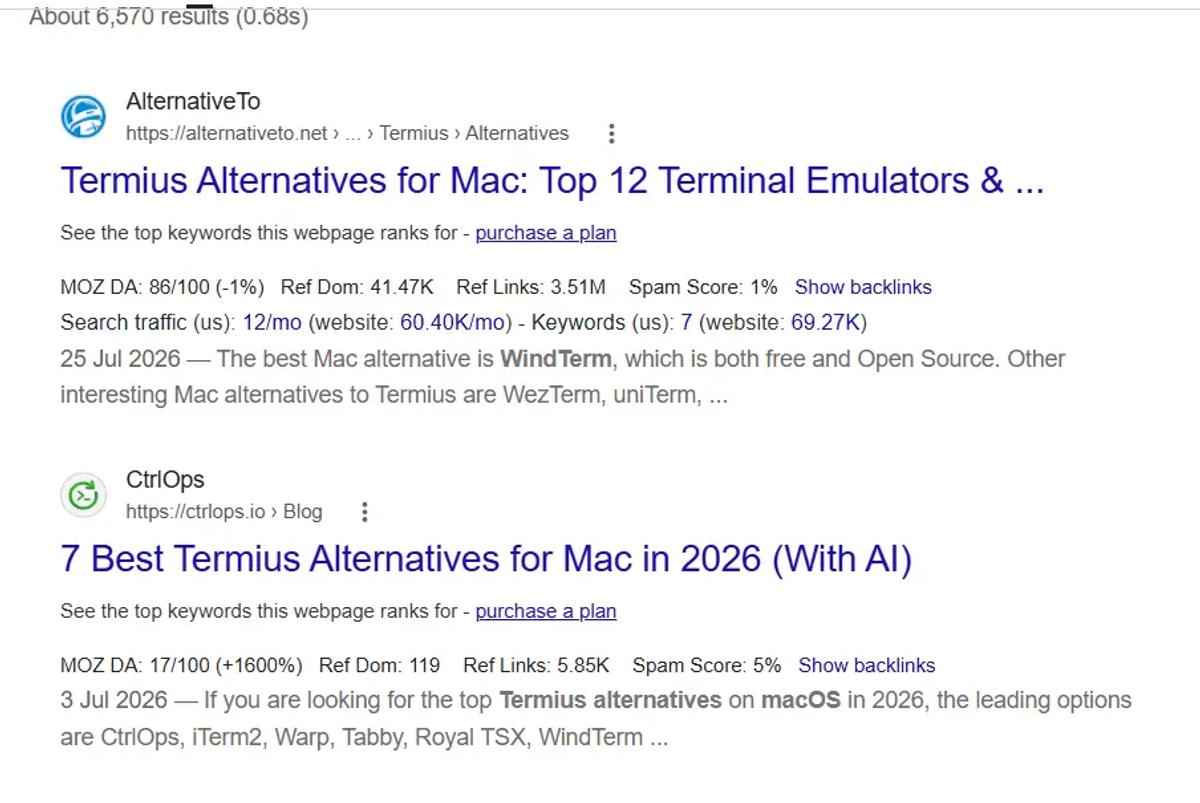
The domain was only five months old when these results were obtained. Four months of active SEO work. No massive link-building campaigns. No paid promotion. No domain age benefits. Just strategy, research, and focused implementation.
What difference did it really make?
It wasn't one thing. It was a combination.
Narrow keyword focus: Instead of spreading our efforts across hundreds of keywords, we focused on six. This allowed us to invest real research depth into each keyword instead of publishing small amounts of content.
In-depth SERP research: We had no idea what content would rank. We studied every competitor on page one, identified what was missing, and built our content strategy around those gaps.
Search intent alignment: Every piece of content was designed to satisfy the reason someone typed in that query. Not just to include keywords to answer the question.
Content Authority: Six interconnected content areas, which reinforce a single topic. The website does not attempt to cover everything. It attempts to be the best resource for a specific topic.
Information Retrieval: Our content provided comparisons, insights, and practical details that weren't available anywhere else on the SERP. This gave Google a reason to rank our page above established competitors.
Entity and Brand Visibility: We built contextual brand presence beyond just backlinks, with relevant mentions in communities and spaces where audiences have already spent time.
AI-Ready Content Structure: By organising content for extractability, we gained visibility in AI overviews, Google Images, and Perplexity Surfaces that most competitors were not targeting.
Continuous Implementation: Four months of deliberate, connected work. No shortcuts. No tricks. Just a complex effort applied to a clear strategy.
No single factor could “beat DA 80.” The result came from putting them all together in layers.
“Bhautik took charge of the SEO strategy for Lead Harbor and achieved significant results in a short period of time. His approach included everything from on-page optimization to technical improvements, which significantly improved our search visibility. He is proactive, communicative, and very skilled in modern SEO. I highly recommend him to businesses looking to strengthen their digital presence.”
What does this not mean?
This is where most case studies lose credibility. They present a victory and then suggest that it can be universally replicated. I'm not going to do that.
Does not mean that:
DA doesn't matter. It does matter. There is a real advantage to a higher-authority domain: more indexed pages, more link equity distribution, more trust signals. If two pages are equally relevant, the higher-authority domain will often win.
Backlinks don't matter. They absolutely do. We still benefited from the links we built. The difference was that we didn't rely solely on backlinks to compete.
New websites can always outperform established websites. But they can't. There are many keywords where a five-month-old domain has no real chance of ranking. The key is to pick the right battles.
Publishing six articles is always better than publishing 100. It's not. Scale has its advantages. But for a new domain with limited resources, focus over volume can be more effective.
Google ignores domain authority. It doesn’t. Google uses authority signals as part of its ranking algorithm. This case study shows that authority isn’t the only signal, and for certain queries, other signals may carry more weight than that.
AI search visibility can be guaranteed through a checklist. It can’t be done. We’ve optimized for AI search surfaces and tracked results, but there’s no guaranteed formula for placement in AI overviews or Perplexity citations.
This nuance is important.
The lesson is not that “DA is irrelevant.” The lesson is that a lower-authority website can create a meaningful competitive advantage when it is highly relevant, truly useful, and strategically aligned with a specific query.
The big lesson of SEO
SEO isn't just domain-level competition. It's also query-level competition.
A website can be weak overall and be very strong for a specific topic. That's not a loophole; it's how Google is supposed to work. The best result for a given query should win, no matter how big the domain behind it is.
This is particularly relevant for:
Startups launching new websites. SaaS companies building their first content engines. Individual brands establishing authority in a niche. Local businesses competing with national aggregators. Any company entering a market where incumbents have accumulated domain authority over the years.
You don’t have to wait until your authority score is impressive before you start competing for commercial keywords. You need to identify specific topics where you can be the most relevant, most useful result, and then build local authority centred around those topics.
I have worked with SaaS companies that were stuck on pages 3-5 and moved them to page 1 using the same principles. I've helped local businesses generate thousands of leads by focusing on specific geographic and service-level questions instead of trying to compete nationally. The approach has metrics.
The principle doesn't change: find questions where your local relevance can exceed someone else's domain authority, and implement it deeply.
What would I do if I had a new domain today?
If I were starting from scratch right now, I would follow this framework. This is basically what we did for this project, down to its main steps.
1. Choose a topic that has commercial value: Not ten. Not fifty. A topic where I can actually become a strong resource in 3-6 months.
2. Choose 5-8 closely related keywords: All related to the same topic. All serving the same audience. Mixed purpose: Some commercial, some informational, some comparative.
3. Map search intent for each keyword: Understand exactly what searchers expect when they type in each query. Don't guess. Study the SERPs.
4. Analyse every serious competitor: Not just the top result. Study positions 1-10. Identify what each page covers, what it misses, and what opportunities exist.
5. Identify gaps in the content: Find information that no one is providing. Find questions that no one is answering well. Find depth that no one is reaching.
6. Create a local ecosystem: Create a small cluster of interconnected pages. Each page should be useful in its own right and reinforce the other pages.
7. Write truly useful content: Not content designed to fill the word count. Content designed to help the reader make a decision, solve a problem, or understand a topic better than any other page on the SERP.
8. Build brand and entity visibility: Get mentions in relevant spaces. Create a consistent brand presence around the topic. Start establishing entity identity.
9. Optimise for Google and AI search: Structure content for traditional ranking and AI extraction. Use clear answer blocks, structured data, and logical content organisation. Track visibility in platforms like AI Overview and Perplexity AI visibility tools.
10. Track, learn, adjust: Monitor rankings, SERP changes, and AI search visibility. Double down on what’s working. Fix what’s not.
This framework is not a basic theory. This is actually what we did. And it worked against a competitor with 80 DA and millions of backlinks.
Final Takeaway
If your domain is new, the answer is not to wait until your authority score looks impressive.
Sometimes a good strategy is to first be highly relevant to a small segment of the market. Own that topic. Be the resource Google uses when someone searches for it. Then expand from a strong position.
The DA 80 competitor in this case study wasn’t doing anything wrong. They had a strong domain, legitimate authority, and decent content. But their content on this particular topic was just one article out of thousands.
It wasn’t built for depth. It wasn’t connected to the broader local ecosystem. It wasn’t designed for AI search. And it wasn’t focused enough to beat a website dedicated entirely to the topic.
Authority is important. But relevance, depth, and usefulness are important for each question.
Create systems, not just rankings.
Do you have a competitive keyword that you can't find? I analyse SERPs, competitors, and local rankings for a living. If your website is struggling against high-authority competitors, A focused strategy session can help you find what they are missing.
Frequently Asked Questions
100 Best SEO Keywords for Coaches: 2026 Research List
October 10, 2026
Fractional SEO vs Agency vs In-House: Which Should You Hire?
October 7, 2026
Need Help With Your SEO & GEO Strategy?
Every article comes from real client work and tested systems. If you want these strategies applied to your business - let's talk.
