
New website SEO case study: #1 in India, #2 in the US in 20 days.
A client site, 40 days old, with zero backlinks, up against domains with years of authority. One page, built around exactly what searchers wanted, reached the top of Google in both markets.
- Page published
- ~ day 20
- Google India
- #1
- Google USA
- #2
- Backlinks
- 0
The short version
Authority helps.
Intent wins the query.
This new website SEO case study follows a client's software site that was only 40 days old, with no backlinks. I picked a query the site could realistically win, studied what searchers expected, and built one page that answered it better than the established results. Within 20 days of publishing it ranked #1 on Google in India and #2 in the USA, and Google's AI Overview cites it as a source.
Writing pages that both rank and get quoted is the core of answer engine optimization.
- Client
- Software tool, new website (anonymous)
- Markets
- India and USA
- Site age
- 40 days when it ranked
- Backlinks
- None
- Also
- Cited as a source in Google's AI Overview
The timeline
Forty days of domain age.
Twenty days to the top.
- Day 0
Site goes live
A new domain. No history, no links, no rankings.
- About day 20
Target page published
One page, built around exactly what searchers for the query wanted.
- Day 40
#1 India, #2 USA
Twenty days after publishing, the page sits at the top of Google in both markets.
Publish date is approximate: a 40-day-old site that ranked within 20 days of publishing.
Why it won
They had the authority.
This page had the answer.
On a specific query, Google weighs how well a page satisfies the search, not only how strong the domain is. That's the gap a new site can use.
What competitors had
- Years of domain history
- Large backlink profiles
- Many indexed pages
- Brand recognition
What this page had
- The exact answer the searcher wanted
- A structure Google could read at a glance
- A clear heading for every sub-question
- Internal links to related pages
The scale tipped toward intent. #1 in India, #2 in the USA.
How the page was built
Four steps,
one page at a time.
No volume play. Fewer pages, each one built to be the best result for its query.
- 01
Read the results page first
Studied what already ranked: the format, the depth and the questions each result answered.
- 02
Pick a query the site could win
Chose an angle where page quality mattered more than domain age.
- 03
Answer before anything else
Put the direct answer at the top, then a heading for every follow-up question.
- 04
Connect it to the site
Linked related pages together so Google could see the topic, not just one page.
Two markets
Same page, same query.
Top two in both countries.
Google ranks each country on its own. The page held position 1 in India and position 2 in the USA.
- 1Client page
- 2Established publisher
- 3Large review site
- 1Established publisher
- 2Client page
- 3Large review site
The bonus
Ranked on Google.
Quoted by its AI Overview.
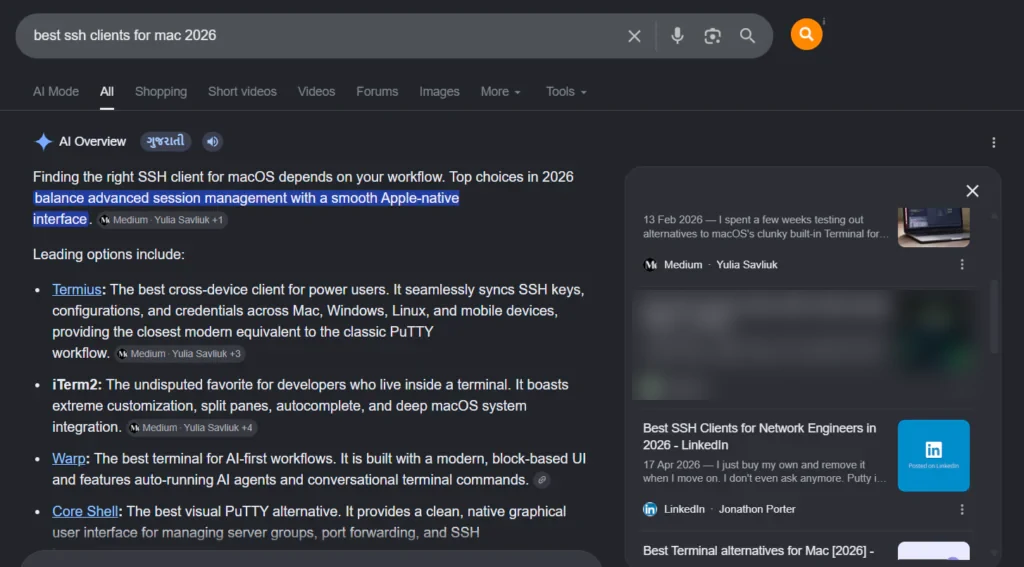
The structure that won the ranking also made the page easy for Google's AI to quote. Here is how to read the screenshot.
- 1
The query
A commercial "best tools" search: the kind of query buyers type when they're ready to choose.
- 2
Google's AI Overview
Google answers at the top of the page, before the regular results, and lists its sources on the right.
- 3
The client page as a source
The same page that ranks #1 in India is cited in the source panel. The card is blurred to keep the client anonymous.
Is this you?
When this approach fits,
and when it doesn't.
A good fit if
- Your site is new and competitors have years of authority
- You can't wait months for backlinks to build up
- You want each page to rank on Google and get cited in AI answers
- You'll publish fewer, better pages instead of many thin ones
Probably not a fit if
- You want a guaranteed #1 for a head term in 20 days
- You need hundreds of pages published fast
- You're not willing to change how pages are structured
FAQ
Questions about
ranking a new website.
Something else on your mind? Email me at hello@bhautikkapadiya.com.
More results
Other projects,
same measured approach.
Your turn
New site, strong competitors?
Start with the queries you can win.
Book a free 15-minute call. We'll find the searches your site can realistically rank for first, on Google and in AI answers.
I take on a limited number of retainer clients at a time.